
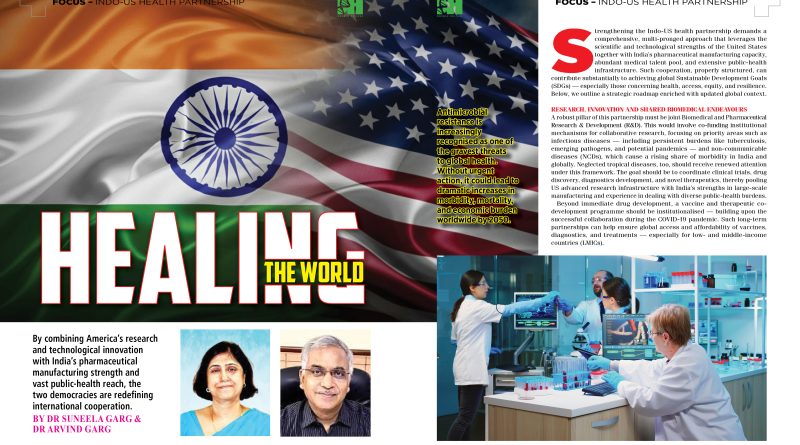
Healing the World
By combining America’s research and technological innovation with India’s pharmaceutical manufacturing strength and vast public-health reach, the two democracies are redefining international cooperation.
By Dr Suneela Garg & Dr Arvind Garg


Strengthening the Indo-US health partnership demands a comprehensive, multi-pronged approach that leverages the scientific and technological strengths of the United States together with India’s pharmaceutical manufacturing capacity, abundant medical talent pool, and extensive public-health infrastructure. Such cooperation, properly structured, can contribute substantially to achieving global Sustainable Development Goals (SDGs) — especially those concerning health, access, equity, and resilience. Below, we outline a strategic roadmap enriched with updated global context.
Research, Innovation and Shared Biomedical Endeavours
A robust pillar of this partnership must be joint Biomedical and Pharmaceutical Research & Development (R&D). This would involve co-funding institutional mechanisms for collaborative research, focusing on priority areas such as infectious diseases — including persistent burdens like tuberculosis, emerging pathogens, and potential pandemics — and non-communicable diseases (NCDs), which cause a rising share of morbidity in India and globally. Neglected tropical diseases, too, should receive renewed attention under this framework. The goal should be to coordinate clinical trials, drug discovery, diagnostics development, and novel therapeutics, thereby pooling US advanced research infrastructure with India’s strengths in large-scale manufacturing and experience in dealing with diverse public-health burdens.
Beyond immediate drug development, a vaccine and therapeutic co-development programme should be institutionalised — building upon the successful collaboration during the COVID-19 pandemic. Such long-term partnerships can help ensure global access and affordability of vaccines, diagnostics, and treatments — especially for low- and middle-income countries (LMICs).
Moreover, technology transfer and innovation exchange should be formalised. Advanced US medical technologies — ranging from genomics, bioinformatics, and diagnostics to digital health tools — can be adapted to Indian conditions. Simultaneously, India’s private sector, known for low-cost scalable solutions suited to resource-constrained settings, should be actively engaged. To facilitate this, joint Industry Innovation Forums could be established, encouraging private-sector entities from both countries to collaborate on cost-effective, scalable health solutions tailored for developing nations.
Public Health Systems Strengthening, Surveillance & Digital Health Integration
The backbone of a resilient health system lies in its public-health infrastructure and the strength of its surveillance mechanisms. To this end, a priority should be placed on pandemic preparedness, early warning systems, genomic sequencing, and bioinformatics capacities in India, building upon the expertise of US agencies such as the Centers for Disease Control and Prevention (CDC) and the National Institutes of Health (NIH). By upgrading surveillance networks and integrating genomics tools, India can detect and respond to outbreaks rapidly — fulfilling global responsibilities and protecting its population.
Simultaneously, cooperation in health systems strengthening — particularly at the primary care level — is essential. Collaborative programmes could support maternal and child health initiatives, address rising burdens of NCDs and mental health, and bolster capacity by training healthcare professionals: doctors, nurses, technicians — especially in underserved or rural areas. Training, infrastructure support, knowledge exchange, and resource sharing should form part of a long-term cooperation agenda.
In the current digital era, digital health and telemedicine offer vast opportunities. The Indo-US partnership should aim to integrate digital health solutions — for instance utilising the Indian national programme Ayushman Bharat Digital Mission (ABDM) — leveraging AI, data-science, and telemedicine to extend care to remote regions, manage large-scale health data, and improve diagnostic reach. Combining US technological expertise with India’s scale can bridge health access gaps and generate models suited for LMICs globally.
 The Rising Challenge of NCDs — Why the Clock Is Ticking
Non-communicable diseases (NCDs) already dominate global mortality and disability burdens. In 2021 alone, NCDs were responsible for over 43 million deaths worldwide, amounting to roughly 75 per cent of all non-pandemic-related deaths. Among these, cardiovascular diseases caused about 19 million deaths, followed by cancers (~10 million), chronic respiratory diseases (~4 million), and diabetes and related conditions accounting for over 2 million deaths. Alarmingly, about 18 million of these deaths occurred in people younger than 70 years — with 82% of such premature deaths in low- and middle-income countries (LMICs).
In addition to mortality, NCDs impose enormous disability burdens: globally, in 2021, NCDs accounted for nearly 1.73 billion disability-adjusted life years (DALYs), underscoring the immense burden of chronic disease on health systems and societies.
These data highlight why cooperation on NCD prevention, early detection, treatment, and management must be a central feature of any Indo-US health partnership. Without decisive, coordinated action, NCDs risk derailing global efforts to meet Sustainable Development Goals on health, equity, and economic productivity.

Regulatory Cooperation, Supply Chains, and Streamlined Trade in Medical Products
For collaboration to yield tangible results — especially in drugs and medical devices — regulatory harmonisation is crucial. A concerted effort towards mutual recognition between the U.S. Food and Drug Administration (FDA) and India’s Central Drugs Standard Control Organisation (CDSCO) — or at least mutual alignment of standards — can increase global confidence in Indian-manufactured pharmaceuticals and medical devices. This, in turn, would streamline supply chains and foster equitable global access to high-quality medicines.
Complementing regulation, it is essential to invest in resilient pharmaceutical supply chains — especially for Active Pharmaceutical Ingredients (APIs) and critical medicines — thereby reducing global dependency on single sources. Strengthening Indian manufacturing capacity, ensuring quality standards, and facilitating trade will enhance global health security and reduce supply fragility.
The Emerging Threat of Antimicrobial Resistance (AMR) — A Global Time Bomb
Antimicrobial resistance (AMR) is increasingly recognised as one of the gravest threats to global health. A comprehensive 2024–25 global analysis forecasts that, without urgent action, AMR could lead to dramatic increases in morbidity, mortality, and economic burden worldwide. Estimates suggest that millions of deaths — currently already significant — could rise sharply by 2050 if new antibiotics, diagnostics and stewardship programmes are not developed and deployed.
Given this, a coordinated Indo-US strategy on AMR is not optional — it is essential. This should involve joint research in new antimicrobials, development of rapid diagnostics, stewardship frameworks, and “One Health”-based surveillance systems covering human health, agriculture, and environment. Strengthening regulatory cooperation and ensuring quality-assured production will also be critical to preventing the spread of resistant pathogens — thereby protecting not only India and the US but global health security.

Shifting From Aid to Strategic Co-Development: Post-COVID Realities and New Priorities
The COVID-19 pandemic changed the contours of health cooperation globally. The Indo-US health dialogue has accordingly shifted from transactional aid to a deeper, more strategic co-development partnership. A case in point is the emerging US India Cancer Moonshot Dialogue — a collaborative initiative focusing on cancer prevention, genomics, precision medicine, and AI-enabled cancer care in the Indo-Pacific region. This reflects a broadening agenda — beyond infectious diseases — into NCDs, chronic disease management and long-term health security.
Pandemic preparedness remains high on the agenda. Joint efforts in outbreak surveillance, data sharing, field epidemiology training, and early warning systems aim to create a robust framework resilient to future global health emergencies.
Another shared priority is combating AMR through coordinated research, prudent antibiotic use, surveillance under “One Health”, and promotion of rational use of antibiotics. Regulatory cooperation, research collaboration, and sharing best practices can help address this growing threat.
By combining India’s pharmaceutical manufacturing strength with US innovation and regulatory support, this partnership also has the potential to improve affordable access to medicines globally — especially generics and essential drugs, including anti-TB medications — thereby serving low-income countries and strengthening global health equity.
Expanding Reach: Regional Cooperation, State-Level Engagement & Triangular Cooperation
To maximise impact, the collaboration should extend beyond national-level agreements. Through triangular cooperation frameworks, India and the United States could jointly help third-party countries — especially in the Indo-Pacific region — strengthen their health systems, manage infectious diseases, and build resilience.
Within India, engagement should also extend to state governments. Since health policy implementation largely happens at the state level, state-level partnerships, customised to regional needs (maternal health, NCD management, rural health system strengthening), will ensure more effective outcomes than one-size-fits-all national programmes.
Why This Matrix of Cooperation Matters — For SDGs and Global Health Security
The rationale for deep Indo-US health cooperation rests on more than bilateral goodwill — it is essential for achieving global Sustainable Development Goals around health (SDG 3), equity, and resilience. By combining research, manufacturing, public-health capacity, regulatory alignment, and digital health, the partnership can deliver affordable, accessible, resilient health systems — not only for India and the US, but for many developing countries.
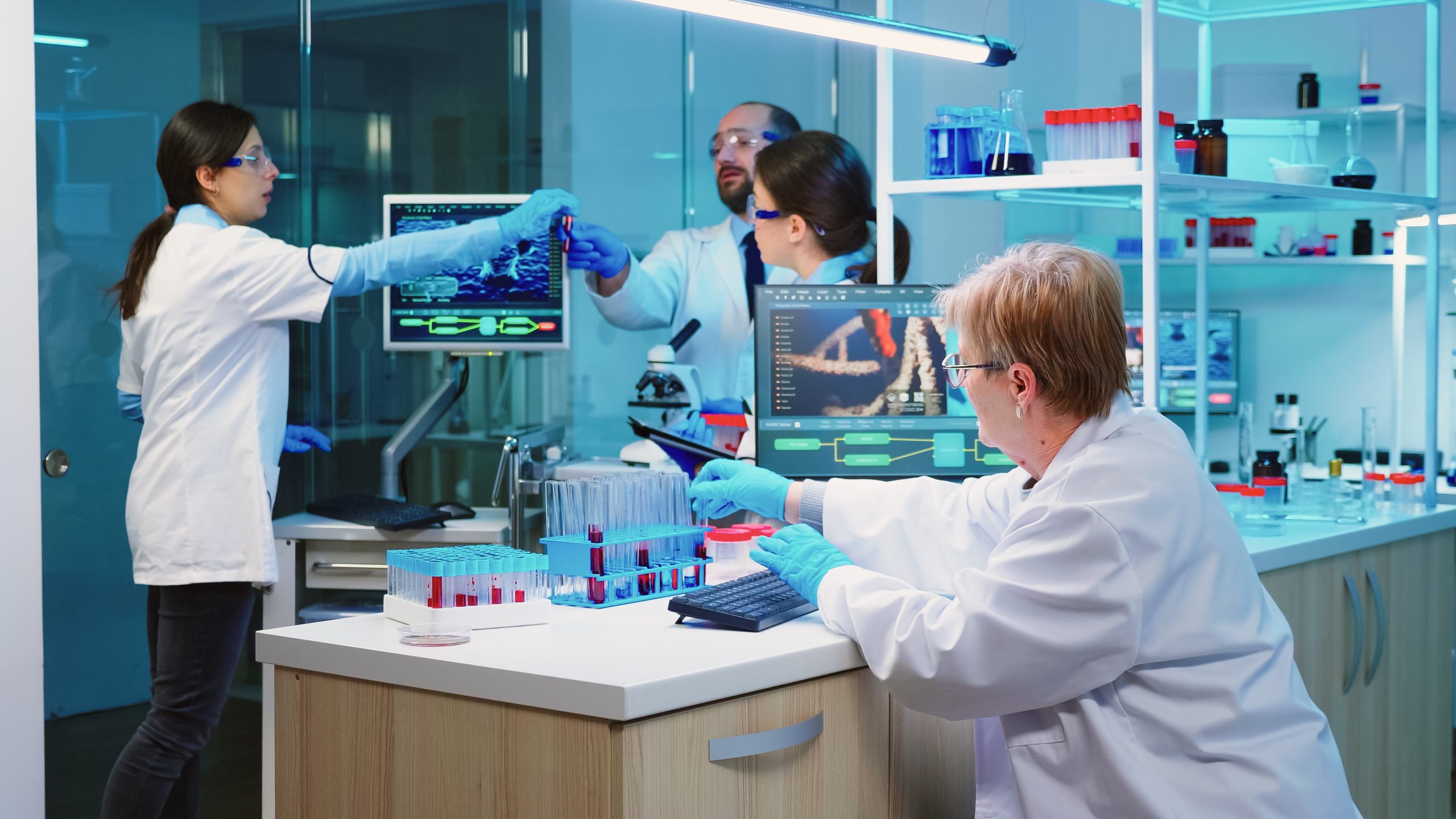
In a world increasingly beset by pandemics, drug-resistant infections, climate-linked health challenges, and chronic disease burdens, such a partnership offers a model of global health security rooted in shared responsibility, scientific collaboration and equitable access.
Bottom Line
The path ahead for India–US health cooperation must look beyond episodic crises and charity-based aid. It must chart a course grounded in sustained collaboration, mutual capacity building, shared innovation, and equitable access. A strong partnership — drawing on the best of both countries — has the potential not only to transform domestic health outcomes but also to influence global health policy, shape drug affordability, combat emerging diseases and strengthen pandemic preparedness.
With robust data, evidence-backed strategies, and a commitment to equity, this Indo-US health cooperation can become a powerful engine for global health — but only if both sides act with urgency, vision, and shared responsibility.
(The authors are Chair, Program Advisory Committee (November 2021–February 2025), National Institute of Health & Family Welfare / Senior Child Specialist, Apollo Hospital, New Delhi)