
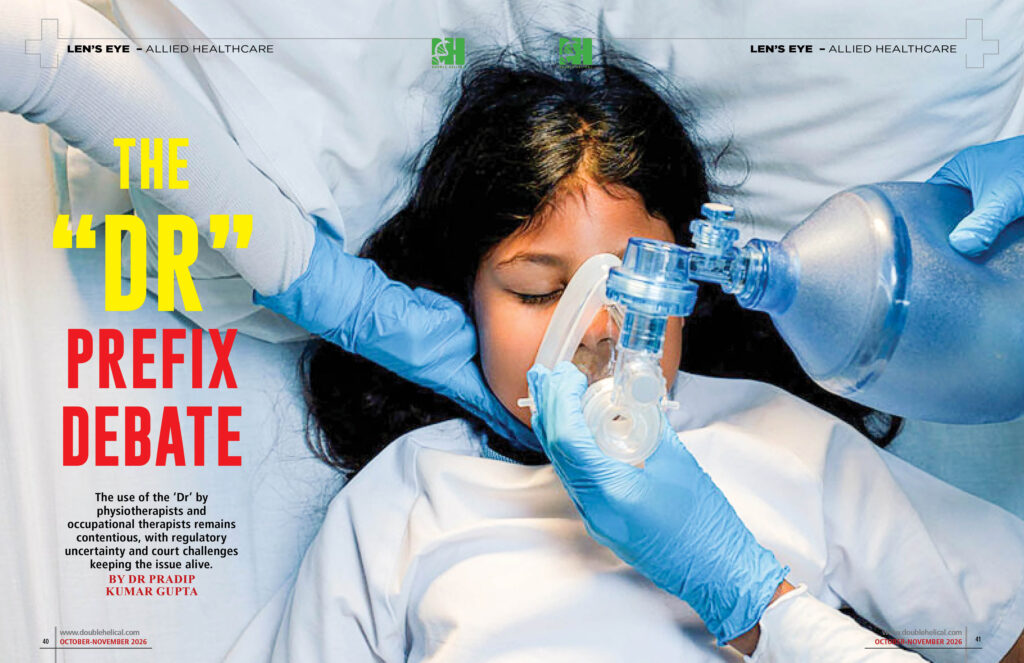
The “Dr” Prefix Debate
 The use of the ‘Dr’ by physiotherapists and occupational therapists remains contentious, with regulatory uncertainty and court challenges keeping the issue alive.
By Dr Pradip Kumar Gupta
The National Commission for Allied and Healthcare Professions (NCAHP) Act, 2021 was a necessary reform. For decades, allied and healthcare education developed under different universities, hospitals, State authorities, and private institutions, producing wide variations in course names, duration, curriculum, clinical exposure, and professional standards. The Act created, for the first time, a national framework for regulating education and professional services, assessing institutions, maintaining Central and State Registers, and promoting research and scientific advancement.
The need for regulation is not in dispute. The concern is whether standardisation is being equated with longer courses, additional internships, and enhanced professional titles without first ensuring adequate clinical material, trained supervisors, affordable fees, and clearly defined scopes of practice. A course becomes stronger through demonstrable competence—not merely through the addition of semesters.
 The Regulatory Structure
The Act distributes responsibility among related national and State institutions:
This structure can bring coherence to a previously fragmented field. It may, however, also produce excessive standardisation if course duration is prescribed without sufficient attention to the competencies required for each profession or to an institution’s capacity to provide supervised clinical training.
The Act itself distinguishes between two broad groups. An allied health professional ordinarily completes a diploma or degree comprising at least 2,000 hours over two to four years. A healthcare professional completes a degree comprising at least 3,600 hours over three to six years. These ranges recognise that occupations carrying different levels of responsibility and risk need not all follow the same educational model. The spirit of this distinction should not be lost during implementation.
The Expansion of Course Duration
Medical knowledge has expanded enormously since Independence. Yet the duration of the MBBS programme has remained broadly stable for decades, even while its curriculum has repeatedly been revised. Several allied health programmes, by contrast, have progressed from hospital-based certificates or short diplomas to four- or five-year bachelor’s programmes, often with a compulsory internship.
The following comparison is indicative. The position around 1947 and 1980 was not governed by a single national framework and varied among universities, hospitals, and States. Those entries, therefore, represent common patterns rather than uniform national rules. The 2026 column similarly reflects the emerging national direction and common programme structures; implementation may differ by profession and institution.
This evolution has brought genuine benefits. Students receive a broader scientific foundation, a stronger professional identity, and greater opportunity for postgraduate study. Standardised qualifications may also improve mobility between States and, in some instances, international recognition. These advantages, however, do not by themselves justify making nearly every allied health programme progressively longer.
More Time Does Not Automatically Mean More Knowledge
Curriculum duration should follow the competencies required for safe practice. It should not be determined by professional prestige, international comparison alone, or the commercial value of selling a longer degree.
 The relevant questions are practical:
What procedures must a graduate perform independently and safely?
How many supervised cases are required to acquire and demonstrate each skill?
What level of assessment and clinical reasoning is necessary within the profession’s defined scope?
Does the institution possess the patients, departments, equipment, and qualified supervisors needed to teach those competencies?
Could the same outcomes be achieved through a well-integrated three- or four-year programme instead of a longer course followed by a weak internship?
The NCAHP’s competency-based approach is sound in principle. Its curricula emphasise early clinical exposure, skill laboratories, supervised practice, logbooks, and measurable outcomes. The danger arises when institutions comply with the prescribed number of years but cannot provide the clinical experience for which those years were added. Regulation then measures time served rather than competence acquired.
Clinical Education Without a Clinical Ecosystem
Allied health education is inseparable from patient care. A physiotherapist cannot learn rehabilitation only through lectures. An occupational therapist cannot acquire functional-assessment skills without observing and treating patients. A laboratory professional cannot become competent without supervised work across an adequate range and volume of specimens. A radiographer, operation-theatre technologist, dialysis technologist, or respiratory therapist cannot be trained safely without functioning clinical departments.
Many programmes are nevertheless offered by stand-alone institutions without a medical college, a multidisciplinary teaching hospital, or sufficient patient load. Some rely upon memoranda of understanding with distant hospitals. Students may visit such facilities to complete attendance requirements, yet receive limited supervision, incomplete rotations, and too few opportunities to perform or assist in procedures.
An additional internship cannot repair several years of deficient clinical education. If the attached or affiliated hospital lacks patients, departments, equipment, or trained preceptors, the internship may become an attendance exercise. Students lose another year, families bear further expenditure, and the health system receives graduates whose qualifications are longer but whose competence remains uncertain.
The Commission’s curriculum framework recognises this risk. It places responsibility on teaching institutions to arrange appropriate hospitals, clinical supervision, logbooks, transport where facilities are off-campus, and reasonable stipends for interns. These requirements must become enforceable conditions of recognition rather than aspirations recorded in a handbook.
Clinical Training Must Begin Within the Course
Allied health education is applied education. Supervised clinical work should begin early and increase progressively throughout the programme. Theory, simulation, and bedside, laboratory, or rehabilitation practice should reinforce one another rather than appear as disconnected stages.
Internship remains valuable when it provides responsibilities and competencies that cannot reasonably be acquired earlier. It should not become a universal substitute for inadequate practical teaching during the academic years. For some allied health disciplines, a well-designed three-year degree containing the prescribed hours and continuous supervised clinical training may produce a safer and more employable graduate than a nominally longer programme with poor patient exposure. Higher-risk or more complex professions may reasonably require four or five years. Duration must, therefore, be justified profession by profession and competency by competency.
 The Economics of Prolonged Education
Every additional year imposes three separate costs: another year of tuition and institutional charges; another year of accommodation and living expenditure; and another year during which the student cannot earn. The burden falls most heavily on families of modest means.
Private tuition varies greatly among courses and institutions. In several allied health programmes, annual fees range from tens of thousands of rupees to several lakh, before accommodation, examinations, equipment, transport, and internship expenses are added. National income-tax statistics may record more than eight crore individual return filers, but the filing of a return is not evidence that a household can finance several years of private professional education. Even the earlier estimate—approximately four crore taxpaying families with some capacity to consider private professional education—is only a broad analytical assumption, not a direct measure of affordability. The number able to bear four or five years of fees without serious debt is smaller still.
Course length must, therefore, be treated as an equity issue. An additional year should be imposed only when the regulator can identify the competencies it adds and demonstrate that recognised institutions can actually teach them. Where an internship is full-time and productive, students should receive a reasonable stipend. They should not be charged another full year of tuition merely for being placed in an outside hospital.
The “Dr” Prefix: Recognition or Confusion?
The word doctor has an academic history extending beyond medicine. In a hospital or clinic, however, the public commonly understands “Dr” to mean a person qualified and registered to practise medicine. The dispute is, therefore, not merely about professional prestige. It concerns patient comprehension, scope of practice, referral responsibility, and accountability when harm occurs.
The 2025 NCAHP curricula recommended the prefix “Dr” with the suffix “PT” for physiotherapists and “OT” for occupational therapists. On 9 September 2025, the Directorate General of Health Services directed removal of the prefix from the physiotherapy curriculum. That communication was withdrawn the following day because the matter required further examination and deliberation.
Judicial decisions have not been uniform. In Sri Sarjoo Prasad v. State of Bihar (2003), the Patna High Court held that physiotherapists and occupational therapists who were neither enrolled in the State Medical Register nor otherwise authorised under State law could not claim a right to practise modern scientific medicine. In 2022, the Madras High Court rejected a physiotherapists’ association’s claim to use “Dr” as a prefix. A Kerala High Court decision in February 2025 likewise treated the use of the prefix by a physiotherapist, in the circumstances before it, as misleading.
The legal position then shifted under the new regulatory framework. On 22 January 2026, a Single Bench of the Kerala High Court dismissed challenges to provisions of the NCAHP curricula and held that medical statutes did not confer an exclusive right to the title upon medical practitioners. The Court also declined to confine physiotherapists and occupational therapists to a merely supportive role. Appeals against that judgment were admitted by a Division Bench on 2 March 2026. As of September 2026, the appeals remained pending, and no final appellate decision had been located in publicly available reports.
 The present position should, therefore, not be reduced to a table declaring every profession either “fully entitled” or “prohibited”. Statutes, regulatory curricula, and judgments delivered under different legal frameworks intersect. The title question also differs from the separate and more important question of who may practise modern medicine.
Misrepresentation and Unauthorised Practice
Section 34 of the National Medical Commission Act, 2019 prohibits a person who is not enrolled in the State or National Register from practising medicine as a qualified medical practitioner, holding an office reserved for a physician or surgeon, issuing specified medical or fitness certificates, or giving expert evidence on medical matters. Contravention may be punished with imprisonment for up to one year, a fine of up to ₹5 lakh, or both. Under Section 54, a court may take cognisance of an offence under the Act only upon a written complaint by an authorised officer of the Commission, the Ethics and Medical Registration Board, or a State Medical Council.
These provisions should not be paraphrased as creating automatic imprisonment merely for writing “Dr” before one’s name. Liability depends upon the applicable statute, the person’s registration, the representation made to the public, and whether the person has actually held himself or herself out as a qualified medical practitioner or practised beyond the legally permitted scope. Where deception, impersonation, forged credentials, or dishonest inducement is involved, provisions of the Bharatiya Nyaya Sanhita (BNS)—rather than the repealed Indian Penal Code for conduct occurring after 1 July 2024—may also become relevant. Each case turns on its facts.
Whatever final policy or judicial decision emerges, three safeguards are essential:
The professional qualification, statutory suffix, and registration number—such as PT or OT—must be displayed prominently wherever the prefix “Dr” is used.
No title, signboard, prescription, or advertisement should imply registration as an MBBS medical practitioner, or authority to prescribe modern medicines, when such authority has not been granted by law.
Scope of practice, referral responsibilities, and limits of independent care must be defined profession by profession and communicated in language that patients can readily understand.
The words “assess, diagnose and treat” cannot by themselves settle the controversy. Nurses, physiotherapists, occupational therapists, optometrists, and other professionals make assessments and clinical judgments within their respective fields. Their autonomy, however, depends on training, statutory authority, and the risk attached to particular decisions. The answer lies in precise scope-of-practice regulation and transparent identification—not in an ambiguous title, but equally not in denial of legitimate professional expertise.
Autonomy Within Accountable Clinical Networks
Professional recognition need not mean clinical isolation. Complex patients frequently have neurological, orthopaedic, cardiopulmonary, metabolic, or psychiatric conditions that alter the safety and appropriateness of rehabilitation. An apparently simple complaint may conceal a fracture, infection, malignancy, vascular event, or progressive neurological disease. Allied health autonomy must, therefore, be accompanied by defined referral thresholds and access to medical review.
Physiotherapy and occupational-therapy services should be integrated with departments of Physical Medicine and Rehabilitation and, according to the clinical problem, with Orthopaedics, Neurology, Paediatrics, or other relevant specialties. Speech-language and hearing services should have structured referral relationships with ENT, Neurology, Paediatrics, and Rehabilitation Medicine. Any extension of prescribing authority to nurses should operate through defined formularies, competency certification, clinical protocols, audit, and access to medical consultation—particularly through General Medicine or the relevant specialty.
Such arrangements should not reduce trained professionals to passive assistants. Their purpose is to create accountable multidisciplinary care: independent practice within a defined field, compulsory referral when red flags or limits are reached, and shared responsibility for patients whose needs cross professional boundaries. This protects patients while recognising the distinct expertise of every member of the healthcare team.
A More Rational Framework
A national review of allied health education should adopt the following principles:
Competence before duration: Define the skills, case numbers, levels of responsibility, and measurable outcomes required for each profession before prescribing course length.
No course without a clinical base: Recognition should require an attached or formally affiliated teaching hospital with adequate departments, patient load, equipment, and named supervisors. Paper affiliations should not suffice.
Clinical training from the first year: Practical exposure should be distributed throughout the course and recorded through verified logbooks and workplace-based assessment.
Internship according to demonstrated need: Internship should be retained where it adds identifiable competencies. It should not be imposed mechanically on every programme or used to compensate for weak clinical teaching.
Differentiated educational pathways: Two-, three-, four-, and five-year programmes should coexist where justified by different statutory categories, levels of responsibility, and risk. Students seeking advanced specialisation or international equivalence may proceed through structured postgraduate pathways.
Affordable mobility within health education: A common foundation component across health-science programmes should be explored. Subject to seat availability, rigorous standards, and a common merit examination, high-performing students could be permitted defined bridge pathways into other professional programmes, including MBBS or BDS. Such mobility must be transparent and must never amount to automatic transfer.
Protection during internship: Full-time interns should receive reasonable stipends, supervision, and insurance. Institutions should not collect a full additional year of tuition for an internship delivered mainly through an outside hospital.
Transparent professional identity: Titles, suffixes, qualifications, registration numbers, and limits of practice should be displayed in a form that an ordinary patient can understand.
Referral and escalation protocols: Each profession should have defined red flags, referral thresholds, and access to medical or specialist advice. Multidisciplinary care should be embedded in regulation, not left to informal goodwill.
Periodic independent audit: Course duration, fees, clinical exposure, graduate competence, employment outcomes, and patient-safety indicators should be reviewed at fixed intervals by bodies including educators, employers, working professionals, students, and patient representatives.
Takeaways
India needs a larger, better-trained, and more respected allied health workforce. The NCAHP can make that possible by replacing fragmented standards with coherent national regulation. Its success, however, should not be measured by the number of programmes converted into four- or five-year degrees, nor by the prestige attached to professional titles.
The true measure is whether graduates can perform their defined work safely; whether students receive adequate clinical exposure; whether education remains accessible beyond affluent families; and whether patients can understand who is treating them, within what scope, and under whose accountability.
Regulation must prevent weak institutions from selling time in place of training. Duration should follow competence; clinical responsibility should follow demonstrated skill; professional autonomy should operate within an accountable referral system; and recognition should never come at the cost of affordability or patient clarity.
(The author is a renowned Radiologist based in Delhi / NCR.)