
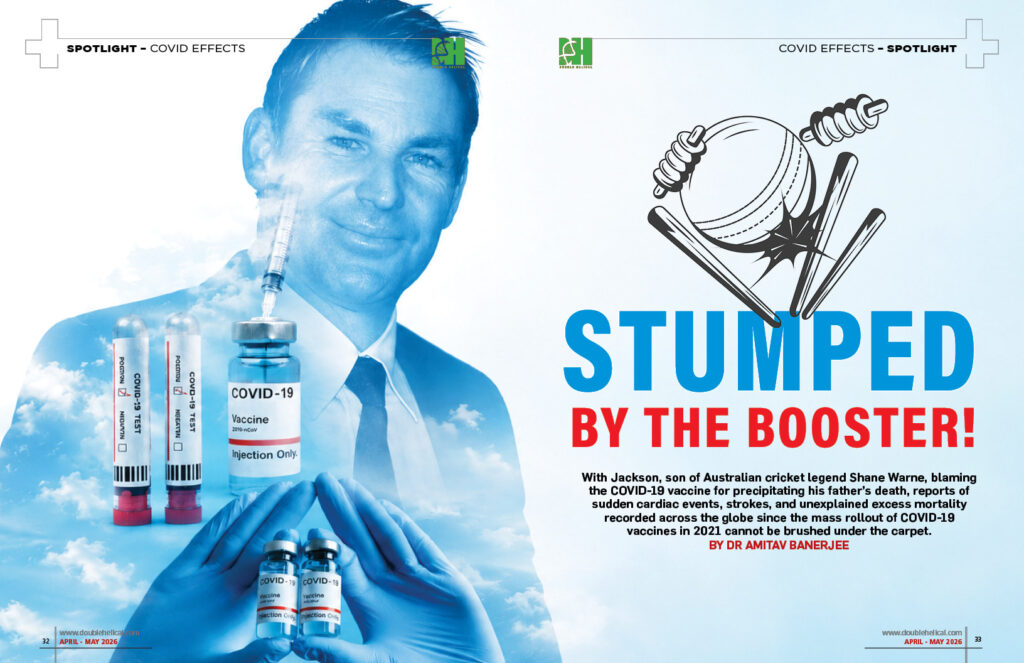
Stumped by the Booster!
With Jackson, son of Australian cricket legend Shane Warne, blaming the COVID-19 vaccine for precipitating his father’s death, reports of sudden cardiac events, strokes, and unexplained excess mortality recorded across the globe since the mass rollout of COVID-19 vaccines in 2021 cannot be brushed under the carpet.
By Dr Amitav Banerjee
Shane Warne, the world-famous Australian cricketer, died suddenly of a heart attack while holidaying in Thailand on March 4, 2022. He lived life “king-sized,” both on and off the field.
He was regarded by connoisseurs of the game as one of the greatest leg spinners, with 145 Test appearances, 708 wickets, and over 3,000 runs as a lower-order batsman. In a country where cricket culture favoured pace bowlers, Shane Warne revolutionised the game by reviving the masterly art of leg-spin bowling. He can be easily compared to Indian spin legends such as Prasanna, Bedi, Venkatraghavan, and Chandrasekhar, among others.
In his heyday, Warne hit the headlines for his antics both on and off the field. These included a ban from cricket for testing positive for a prohibited drug, a colourful personal life, and hobnobbing with gambling figures. He was also a smoker and did drink alcohol. However, his manager cleared the air, stating that prior to his untimely death at the age of 52 years, he was not drinking nor taking any drugs. He was on a weight-loss diet to get in shape. James Erskine, his manager, added that he was on a much-needed vacation in Thailand, after which he was scheduled to travel to England for his professional commitments. He emphasized that contrary to popular opinion, Shane was not a heavy drinker, noting that a crate of wine gifted to him 10 years earlier remained unopened.
Controversy over Shane Warne’s death
Shane Warne, whose life was full of controversies, seems to have his share of them after death as well. A report which surfaced on March 30, 2025, quoted a police officer saying that a bottle of a drug from the site was removed on the orders of some senior people. While a heart attack was cited as the reason for his demise, this revelation sparked fresh controversy. One of the officers investigating the case said an Indian drug may have contributed to his death. This drug, Kamagra—which contains similar ingredients to Viagra and is indicated for erectile dysfunction—was found in his room. However, an autopsy suggested that the cricketer died of natural causes, ruling out the possibility of any conspiracy or drug reaction.
Just when the dust seemed to have settled on the unfortunate event, Warne’s son, Jackson, stated in a recent podcast from Australia that his father’s death was probably precipitated by the three or four COVID-19 jabs he was forced to take against his will due to vaccine mandates.
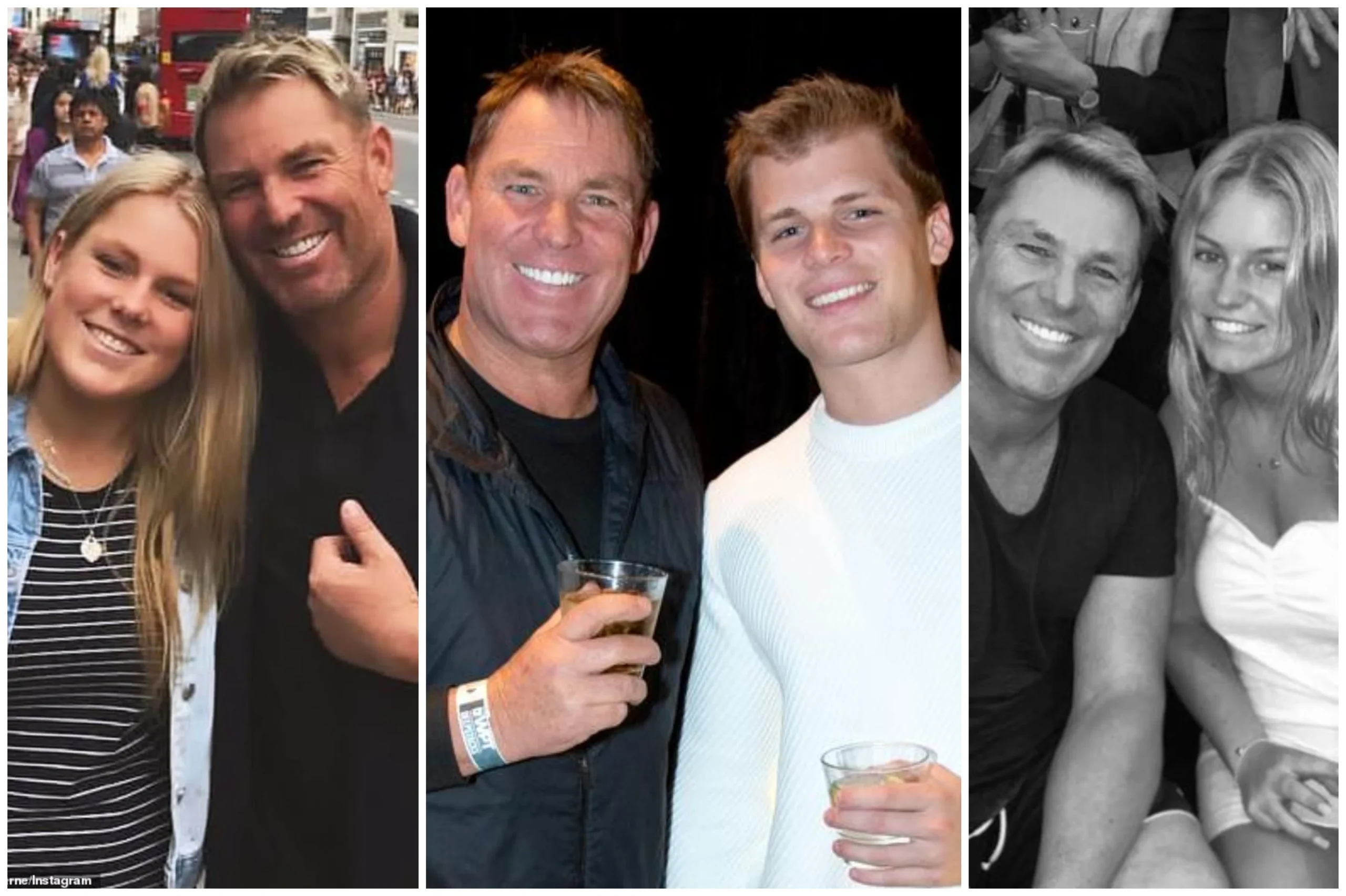 He went so far as to say that this line of thinking is not controversial anymore. Perhaps reports from around the world of rising cardiac and vascular events after population-level mass vaccine rollouts made him think along these lines.
While Jackson admitted that his father had underlying health issues, he asserted that the jabs contributed to the sudden death. What makes the unfortunate and untimely death more poignant (in case the vaccine was responsible) is that Shane Warne had recovered from COVID-19 before taking the shots. By all principles of immunology and current evidence, the jabs were not indicated.
Like a pitch in cricket, deaths in the vaccinated cannot be squarely blamed on comorbidities, if present. Drawing from cricketing logic, the pitch plays an important part in the outcome of the game, particularly in Test matches—Warne’s forte. Dry, dusty, and well-worn pitches favour spin bowling, in which Warne excelled. He could bowl out many batsmen on such pitches compared to, for instance, a mediocre bowler on the same pitch.
Now drawing on this analogy from cricket, even if Shane Warne had comorbidities, an intervention with the potential for harm would cause more damage and precipitate catastrophe compared to no intervention or a bland product. Likewise, just because a person has comorbidities, it should not naturally follow that an intervention with potential for harm had no role in a fatal outcome. On the contrary, a potentially harmful intervention may be more likely to cause harm in a comorbid heart, just like a spinner is more deadly on a dry and dusty pitch. Having said this, it does not naturally follow that the vaccine caused the death of the legendary cricketer. Life, like cricket, often deceives due to the vagaries of chance. For example, even a good spinner may go wicketless on a dry pitch on a bad day. That is why we have to look beyond an individual unfortunate event—even that of a celebrity—to look at the big picture to make an intelligent guess.
Global patterns of deaths after the mass vaccine rollout present some red flags. Reports of people—both healthy and with comorbidities—suddenly collapsing and dying require investigation to determine if there is any correlation with vaccines or something else. Since the mass COVID-19 vaccine rollout, a spike in cases of sudden heart attacks, cardiac arrests, and other cardiovascular complications among all age groups has been reported from across the country; even seemingly fit people have died of cardiac health issues while walking on the street, on the dance floor, and even while just sitting at a desk.
A year into the mass vaccine rollout in India, according to a survey by LocalCircles (a social community platform), 51 per cent of the respondents said they knew one or more persons who had suffered heart attacks, strokes, sudden cancers, or neurological disorders in the recent past. Out of those who experienced such events, 62 per cent of the cases were found to have been double-vaccinated, 11 per cent had received a single dose, and 8 per cent were unvaccinated.
Science demands a detached view, and scientists should not jump to conclusions. One of the requirements for this is discerning any unusual patterns at the population level. This does indicate some cause for concern. The increase in sudden deaths has been reported since early 2021; there was a sixfold increase in heart attacks reported from Mumbai.
The pattern of excess deaths was not, however, restricted to India, but was global. Here we take a close look at two countries from where open data is available: England/Wales and Australia.
In England and Wales, the year 2020 saw an increase of about 13 per cent in overall mortality over the average of the previous five years. What is striking is that even in 2022, after the brunt of the pandemic was over, there was significant excess mortality of about 8 per cent over the 2015-2019 average.
The case of Australia, Shane Warne’s native country, is even more striking, as the country followed a “zero-COVID” policy for a long time, with strict lockdowns as well as coercion and mandates for COVID-19 vaccines. By the start of 2022, it had vaccinated the majority of its population and even booster doses were made available.
The baseline average deaths in the first eight months of the year were just 110,483, while the total deaths in the first eight months of 2022 were 129,513. This represents a 17.2 per cent increase above baseline—even higher than the excess deaths caused by COVID-19 in 2020 in England & Wales.
 Edward Dowd, in his book Cause Unknown: The Epidemic of Sudden Deaths in 2021 and 2022, reports an 84 per cent rise in sudden deaths in the age group of 25–44 years in the USA, coinciding with mass vaccine mandates, which was corroborated by a study of insurance claims.
There are two possible causes for the high excess mortality worldwide. First, these could be the prolonged effects of harsh lockdowns. After all, lockdowns have directly increased diabetes, obesity, starvation, poverty, joblessness, vitamin D deficiency, and the propensity for cancer. A second cause could be the excessive use of COVID-19 vaccines—even among the already COVID-recovered (including Shane Warne) and among the not-at-risk population—without adequate safety data.
The time correlation of heart illnesses with the COVID-19 jab rollout is unmistakable in the worldwide data. While correlation does not mean causation, it certainly is a red flag which must be probed objectively.
A matter of concern is that during the US Senate’s Permanent Subcommittee Hearings on COVID-19 vaccines on May 21, 2025, Dr Peter McCullough, a cardiologist, presented findings from a large autopsy series. He stated that in 73.9 per cent of examined post-vaccination deaths, mRNA COVID vaccines were considered the likely cause—a claim that has sparked intense debate in the medical community.
Given our large population, our data dividend can be a source of robust research by using big data mining to find the patterns of events in the vaccinated and the unvaccinated. These can be corroborated by autopsy studies. In detective work, nothing is above suspicion. Shooing away the possibility of the vaccine being responsible for an adverse event whenever any comorbidity is found is not the correct approach in science nor in detective work.
Bottom Line
Pandemics and wars have much in common. Both are messy and do not turn out according to neat plans. Weapons malfunction in wars; vaccines malfunction in pandemics. Pandemics should never be tackled in “war mode” but in a scientific way. All options should be considered, however far-fetched they may appear. Debate and disagreements strengthen science. Regrettably, these were discouraged during the pandemic, which was approached with warlike urgency.
Lastly, did the COVID-19 vaccine precipitate the death of the legendary cricketer? There are no easy answers. Both yes and no can be the correct answer. Even the best detective fails to solve all cases. But one thing is certain: having recovered from natural infection, the COVID-19 vaccine was not indicated for Shane Warne.
(The Author is a renowned epidemiologist and a Professor Emeritus at DY Patil Medical College, Pune. Having served as an epidemiologist in the armed forces for over two decades, he ranked in Stanford University’s list of the world’s top 2 per cent scientists for three consecutive years (2023-25). He has penned the book, Covid-19 Pandemic: A Third Eye. He is the Chairperson of the Universal Health Organization (uho.org.in), a public health watchdog.)