

Money Marginalises Merit
Over the past four decades, medicine has evolved into the most lucrative, saleable commodity in the education sector.
By Dr Pradeep Gupta
In India’s healthcare architecture, merit has been systematically subordinated to financial capability. The foundational premise of medical training—that life-saving expertise should be built on rigorous intellectual ability, dedication, and clinical competence—is being undermined by commercialisation. With undergraduate National Eligibility cum Entrance Test (NEET) qualifying cutoffs reduced to near 20 per cent marks, postgraduate admissions granted to candidates scoring zero or even negative marks, and hundreds of thousands of high-performing students priced out of the system, a critical question confronts society: Is the medical profession rapidly turning into an exclusive preserve for the wealthy?
The genesis of this systemic breakdown traces back to the aggressive entry of private medical education starting around 1990. This structural transition introduced a commercial ethos into a field that historically demanded pure academic rigor and social service. Rather than nurturing clinical excellence, private institutions were largely established with an orientation toward profit maximisation.

Regulatory Subversion and the Dilution of Standards
This transformation could not have occurred without the tacit compliance and active concessions of governing bodies. Regulatory authorities such as the former Medical Council of India (MCI) and the current National Medical Commission (NMC) have repeatedly submitted to political directives and pressure.
A glaring manifestation of this institutional compromise occurred during admissions in 2023, coinciding with the general election period, when the official merit score requirement for NEET postgraduate admissions was effectively reduced to zero to fill vacant seats. Political power has repeatedly enabled education capitalists to dilute established regulatory codes, systematically lowering entry thresholds to ensure private seats do not remain unpaid or vacant.
The Systematic Obliteration of Merit and Equity
The mechanism of exclusion operates primarily through exorbitant pricing structures. Institutional trustees, collaborating with fee fixation committees and administrative authorities, have institutionalised massive fee frameworks—often reaching `1 crore for a five-year course—thereby effectively circumventing the underlying intent of Supreme Court directives on affordable education.
The Breakdown Across Educational Tiers
- Undergraduate (MBBS / BDS): Over the past decade, achieving a rank at roughly 20 per cent marks has been sufficient to secure an MBBS admission in private colleges. For Dental (BDS) programs, the required threshold has fallen even lower. In effect, academic effort has been decoupled from medical admission—provided a student possesses sufficient wealth, virtually any score on the NEET exam can buy entry.
- Postgraduate (MD/MS): In postgraduate admissions, the threshold has dropped to negative marks. While thousands of high-ranking, meritorious candidates are forced to give up costly postgraduate seats because they cannot afford the fees, failed wealthy students step in to claim these specialised clinical seats.
- Impact on Reserved Categories: High tuition fees operate as a barrier that functionally eliminates candidates from Other Backward Classes (OBC), Scheduled Castes (SC), and Scheduled Tribes (ST) without direct formal policy changes. Because the exorbitant cost creates an insurmountable financial barrier, legal reservations are rendered ineffective in practice for expensive private seats.
Quantum of Capital
The financial scale of private medical education in India has reached massive proportions:
- •Annual Fee Receipts: Private medical institutions generate approximately `1,10,000 crore annually in tuition and operational fee receipts.
- •Refundable Security Deposits: An estimated `5,000 crore is held by these institutions as refundable security deposits collected from students. While government officials set these fee ceilings high, the general public receives virtually no tangible benefit in healthcare quality or affordability in return.
Foreign Medical Graduates (FMGs) vs. Domestic Private Graduates: Institutional Apartheid
A notable contradiction in current regulatory policy is the stark difference in treatment between students who complete their medical degrees abroad and those who graduate from domestic private institutions.
Indian students who choose to study overseas access medical training at roughly 25 per cent of the cost of domestic private colleges. Yet, upon returning, these Foreign Medical Graduates face stringent barriers. They are required to pass the FMGE by securing at least 50 per cent (150 out of 300 marks), an exam where pass percentages regularly fall between 13 per cent and 30 per cent.
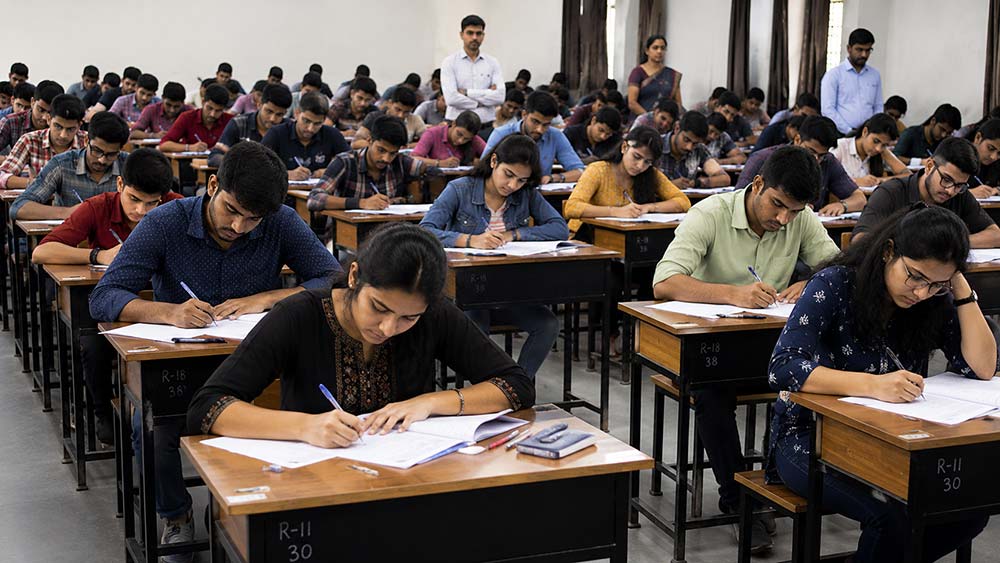 Conversely, domestic private college graduates receive medical registration and PG eligibility without facing a mandatory exit exam, despite entering with near-zero or negative NEET scores. This dual standard discourages students from seeking affordable, quality education abroad while protecting expensive domestic private colleges whose educational quality is often no better. National Medical Commission explicitly clarifies that it does not endorse any specific list of foreign medical institutions or universities for MBBS or equivalent courses. The Screening Test is a statutory requirement for Indian Citizens and Overseas Citizens of India who have obtained a primary medical qualification abroad.
Strategic Remedial Roadmap
To reform the system, structural changes must be enacted across policy, examination, and career stream design:
1. Universal Licensing via National Exit Test (NExT) Architecture:
- PG Prelims / Licentiate Stage: Establish a mandatory, standardised examination equivalent to the FMGE pattern for all medical graduates—both domestic and foreign—required to obtain medical registration.
- PG Mains Stage: Maintain competitive evaluation for postgraduate seat allotment based on advanced clinical merit.
Alternative Career Pathways for Non-Licentiates:
- Candidates who do not clear the primary clinical licensure should be redirected into non-bedside specialties that do not require intensive direct clinical interventions.
- Suggested disciplines include Clinical Epidemiology, Master of Health Administration (MHA), Anatomy, Physiology, Clinical Research Methodology, Pharmacology, and Medical Jurisprudence.
Restoration of Short-Duration Skill Development Courses:
- Re-evaluate the abolition of shorter, low-fee skill courses that previously trained doctors, rather than forcing all candidates into long-duration, high-fee postgraduation.
Takeaways
The proposed NExT represents a vital tool to rebuild integrity in Indian medical education. Introduced under the National Medical Commission Act, 2019 and the National Commission for Indian System of Medicine Act, 2020, NExT is envisioned as a comprehensive, standardized exam for all final-year MBBS students in India.
By serving as a uniform licentiate examination to practice medicine and as the sole criterion for postgraduate admissions, NExT can eliminate double standards, curb the monetisation of seats, and ensure that clinical competence—rather than financial capacity—defines the future of healthcare in India.
(The author is renowned Radiologist.)