
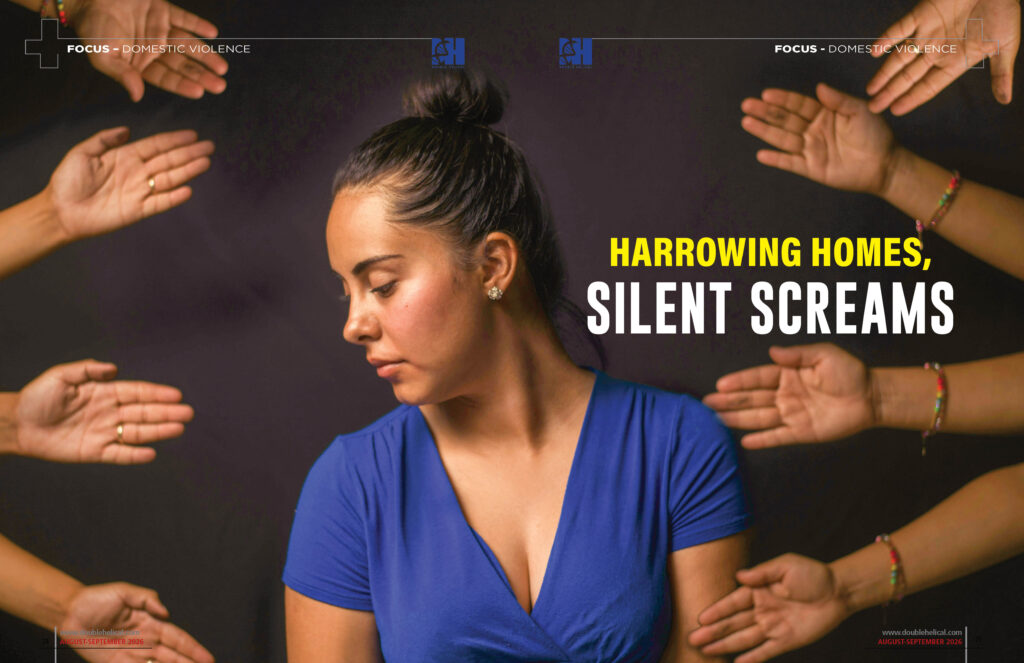
Harrowing Homes, Silent Screams
 Domestic violence remains one of the most prevalent yet underreported public health crises of our time, affecting nearly one in four women globally. In India, the fight against this universal social pathology demands a fundamental shift in societal attitudes and a collective sense of responsibility.
By Dr Amitav Banerjee
Domestic or intimate partner violence is any act of physical, emotional, psychological, sexual, or economic abuse committed by one family member against another, most commonly by a husband or intimate partner against a woman.
The National Family Health Survey – 6 (NFHS-6) has revealed that in India, 22.3 per cent of married women have experienced spousal violence. This is likely an underestimate, since the stigma surrounding domestic violence often results in reticence in admitting instances of abuse.
Intimate partner violence is a global phenomenon and a significant public health threat. The Centers for Disease Control and Prevention (CDC) in the USA reported that nearly 25 per cent of women have experienced severe physical violence from an intimate household member during their lifetime. In spite of this alarming figure, intimate partner violence has remained a hidden pandemic well into the 21st century.
An excerpt from an editorial in the Journal of General Internal Medicine by Elaine Alpert in 2002 sums up the conundrum:
“Over the course of human history, virtually no other public health problem has been as prevalent or as challenging to the health and well-being of humanity as intentional injury. Eclipsed only by war, domestic violence has remained at the forefront of violence-related human morbidity and mortality… Although pandemic in scope, domestic violence until recently remained secret and undefined, in part because historically there was no common language to name the problem, describe its scope, garner the evidence, or take concerted action regarding intervention or prevention.”
 Forms of Domestic Violence
Domestic violence takes many forms beyond physical assault. Physical abuse includes hitting, slapping, kicking, choking, or causing bodily harm. Emotional and psychological abuse involves insults, humiliation, threats, intimidation, isolation from family and friends, and controlling behaviour. Sexual abuse includes forcing a partner into unwanted sexual activities without consent. Economic abuse occurs when a victim is denied access to money, employment, education, or property, making them financially dependent on the abuser. These different forms of violence often occur together, creating a cycle of fear and control that makes it difficult for victims to escape.
Determinants of Domestic Violence
Several factors contribute to domestic violence in India. Alcohol and substance abuse are frequently associated with increased aggression and abusive behaviour, although they are not the sole causes. Dowry-related harassment continues to be a major issue despite laws prohibiting the practice. Disputes over property, unemployment, financial stress, lack of education, and rigid gender stereotypes can also intensify conflicts within families. In some cases, violence is passed down through generations, with children who witness abuse becoming more likely to accept or repeat similar behaviour in adulthood.
In India, domestic violence has deep-rooted social and cultural causes. Traditional patriarchal norms often place men in positions of authority while expecting women to remain submissive. Such gender inequality contributes to the normalisation of abusive behaviour within households. Many women are taught to tolerate violence for the sake of preserving family honour or protecting their children. Financial dependence on abusive partners, fear of social stigma, lack of family support, and concern about the future discourage many victims from reporting abuse. As a result, countless cases remain hidden, making domestic violence a significantly underreported crime.
Collateral Harms of Domestic Violence
Just as charity begins at home, violence in society too has its roots in the household environment one has been exposed to. The recent police violence bordering on sadism, unleashed on students at Jantar Mantar who were demanding reforms in the education and examination system, is perhaps one manifestation of this. It is reminiscent of parents bashing their children at home for some prank. It symbolises the paternalistic authoritarian society where authority cannot be challenged. The traditional “spare the rod and spoil the child” mentality, combined with parental dominance, often extends in the form of duty to the state. Research indicates a strong relationship between trauma in childhood and aggression or violence in adulthood. Witnessing violence and experiencing emotional abuse are associated with a greater number of aggressive behaviours in adulthood. Hurt people hurt other people.
“I and the public know
What all school children learn,
Those to whom evil is done
Do evil in return.”
— W H Auden
 Impact on Victims and Families
The effects of domestic violence are devastating for victims and their families. Physically, victims may suffer injuries, chronic health problems, disabilities, or even death. Emotionally, they often experience depression, anxiety, low self-esteem, post-traumatic stress disorder (PTSD), and feelings of helplessness. Victims may struggle to maintain employment, complete their education, or participate in community life. Domestic violence also affects children who witness abuse. They may develop emotional insecurity, behavioural problems, poor academic performance, and difficulty forming healthy relationships later in life. Thus, domestic violence does not only harm individuals but also weakens the social fabric of society.
The Legal Response in India
Recognising the seriousness of this issue, India has enacted several laws to protect victims. The Protection of Women from Domestic Violence Act (PWDVA), 2005, is one of the most significant legal measures. This law provides protection against physical, emotional, sexual, verbal, and economic abuse. It allows victims to seek protection orders, residence rights, monetary relief, custody of children, and compensation. Additionally, Section 85 of the Bharatiya Nyaya Sanhita (BNS) addresses cruelty by a husband or his relatives. Other legal provisions related to dowry prohibition, sexual offences, and maintenance also provide support to victims. While these laws have strengthened legal protection, effective implementation remains a challenge due to delays in the justice system, lack of awareness, and social pressure on victims to withdraw complaints.
 Role of Government, NGOs, Media, and Cinema
Government agencies, non-governmental organizations (NGOs), women’s commissions, and community organizations play an important role in supporting survivors. Helplines, shelter homes, legal aid services, counselling centres, and medical assistance provide immediate relief and long-term support. Awareness campaigns educate people about legal rights, gender equality, and the importance of reporting abuse. Schools and colleges can contribute by promoting respect, empathy, and healthy relationships among young people. Media and cinema also have a significant role in challenging harmful stereotypes and encouraging open discussions about domestic violence. The stereotype of “Pati-Parmeshwar” (husband as God) can lead to a laissez-faire attitude, which becomes detrimental when “Pati” turns out to be no “Parmeshwar.”
Education and Empowerment
Education and economic empowerment are among the most effective tools for preventing domestic violence. When women have access to quality education, employment opportunities, and financial independence, they are better equipped to make informed decisions and seek help when necessary. Similarly, educating boys and men about gender equality, mutual respect, and non-violent conflict resolution can help transform harmful attitudes. Community leaders, religious organisations, and local governing bodies should actively promote equal treatment and condemn all forms of domestic abuse.
Technology – A Double-Edged Weapon
Technology has emerged as both a challenge and an opportunity in addressing domestic violence. On one hand, digital harassment, online surveillance, and cyber abuse have become new forms of controlling behaviour. On the other hand, mobile applications, online counselling services, emergency helplines, and digital reporting platforms have made it easier for victims to access support and seek assistance confidentially. Expanding digital literacy and ensuring safe access to these services can improve the reach of support systems, especially in rural and remote areas.
Challenging Society: Domestic Violence Is No Private Matter
Changing societal attitudes is equally important. Domestic violence should never be considered a private family matter. Neighbours, relatives, friends, and community members should be encouraged to support victims rather than remain silent. Victim-blaming attitudes must be replaced with compassion and understanding. Employers can also contribute by providing flexible leave, counselling services, and workplace support for employees facing domestic abuse. Collective responsibility can create an environment where survivors feel safe to seek help without fear of judgment or discrimination.
Despite ongoing challenges, there has been gradual progress in increasing awareness about domestic violence in India. More women are coming forward to report abuse, and public discussions about gender equality have become more common. Civil society organisations, legal reforms, and media campaigns have contributed to reducing the silence surrounding domestic violence. However, lasting change requires consistent enforcement of laws, accessible support services, improved education, gender-sensitive policing, and stronger community engagement. Every citizen has a responsibility to challenge harmful beliefs and promote relationships based on dignity, equality, and mutual respect.
The Way Forward
Domestic violence is a serious violation of human rights and a major obstacle to social progress in India. It affects individuals regardless of age, education, religion, or economic background, although women are disproportionately affected. While legal protections and support systems have improved, eliminating domestic violence requires addressing its root causes, including gender inequality, social stigma, and economic dependence. By strengthening legal implementation, promoting education and awareness, empowering women, and encouraging community participation, India can move toward a future where every individual lives in safety, dignity, and freedom from violence. A society that respects equality and protects its most vulnerable members is essential for achieving sustainable development and true social justice.
“If a woman cannot be safe in her own house, then she cannot be expected to feel safe anywhere.”
Aysha Taryam
(The author is a renowned epidemiologist and Professor Emeritus at D Y Patil Medical College, Pune. Having served as an epidemiologist in the armed forces for over two decades, he has ranked in Stanford University’s list of the world’s top 2 per cent scientists for three consecutive years (2023–2025).