
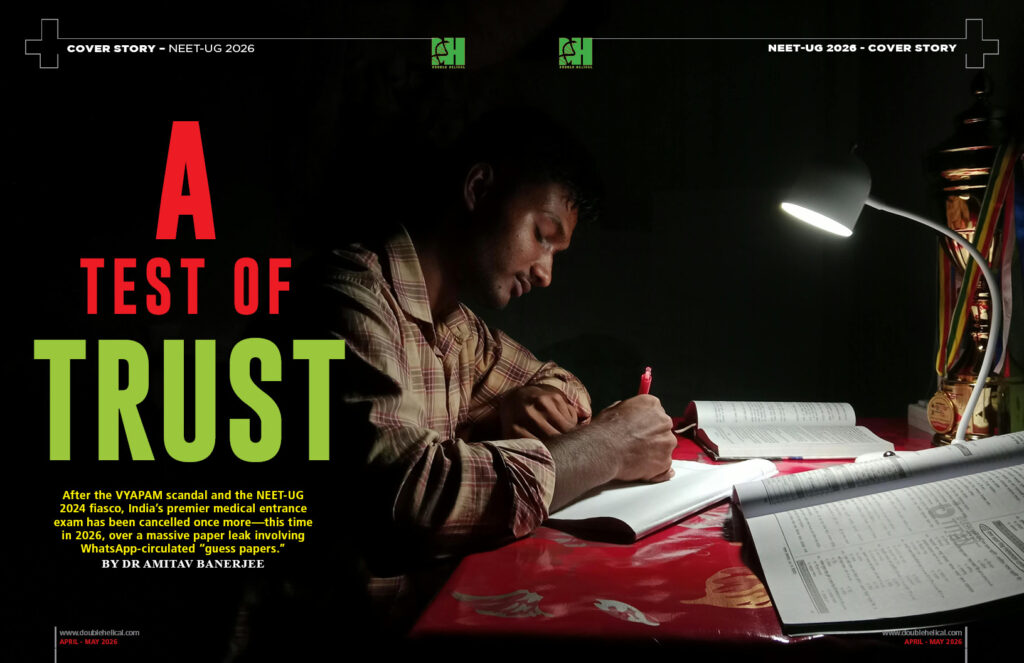
A TEST OF TRUST
 After the VYAPAM scandal and the NEET-UG 2024 fiasco, India’s premier medical entrance exam has been cancelled once more—this time in 2026, over a massive paper leak involving WhatsApp-circulated “guess papers.”
By Dr Amitav Banerjee
After years of gruelling hard work and sacrifice in the prime of their lives, our youth deserve a level playing field in highly competitive entrance examinations like the National Eligibility-cum-Entrance Test for undergraduate MBBS courses (NEET-UG). Transparency and efficiency in the conduct of NEET will not only do justice to their hard work but will also set an example in integrity and values—qualities so essential for those aspiring to enter a noble profession which, traditionally, was a calling. A clean system of entrance examinations will also ensure that only the best and brightest with high moral values enter the demanding vocation.
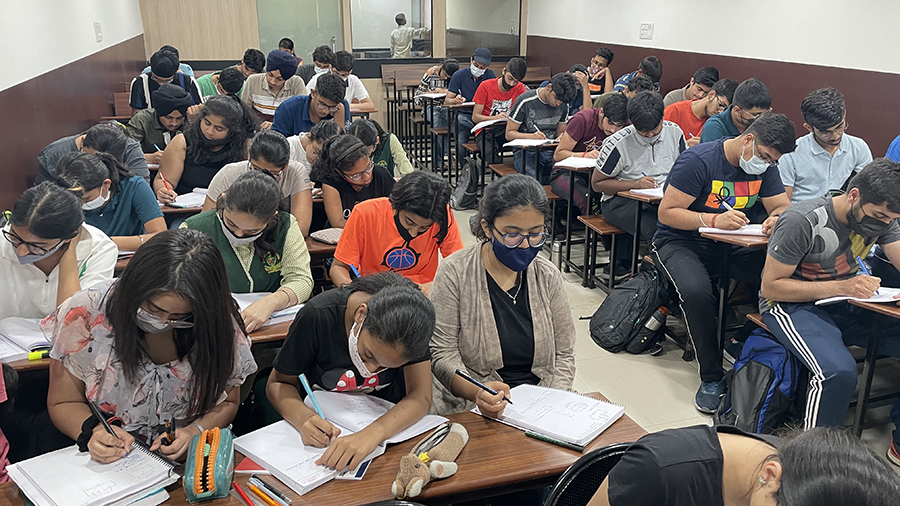
Unfortunately, the reality is far from this ideal. Since medicine continues to be the first career choice for aspiring youth, there is a great mismatch between demand and supply. Over 22 lakh students compete for around 1.3 lakh seats, only about half of which are subsidised government seats affordable to students of modest means. This is exploited at all levels, with the mushrooming of coaching classes driving strenuous, nerve-wracking preparation for the entrance examination. Kota has become the epitome of the coaching culture for aspiring youth. On a much darker note, it has also been hitting the headlines for frequent, tragic suicides of young people cracking under the pressure.
The recent news of the 2026 NEET-UG being cancelled due to paper leaks indicates that the lessons have not been learned from past scams related to entrance examinations to medical courses in the country.
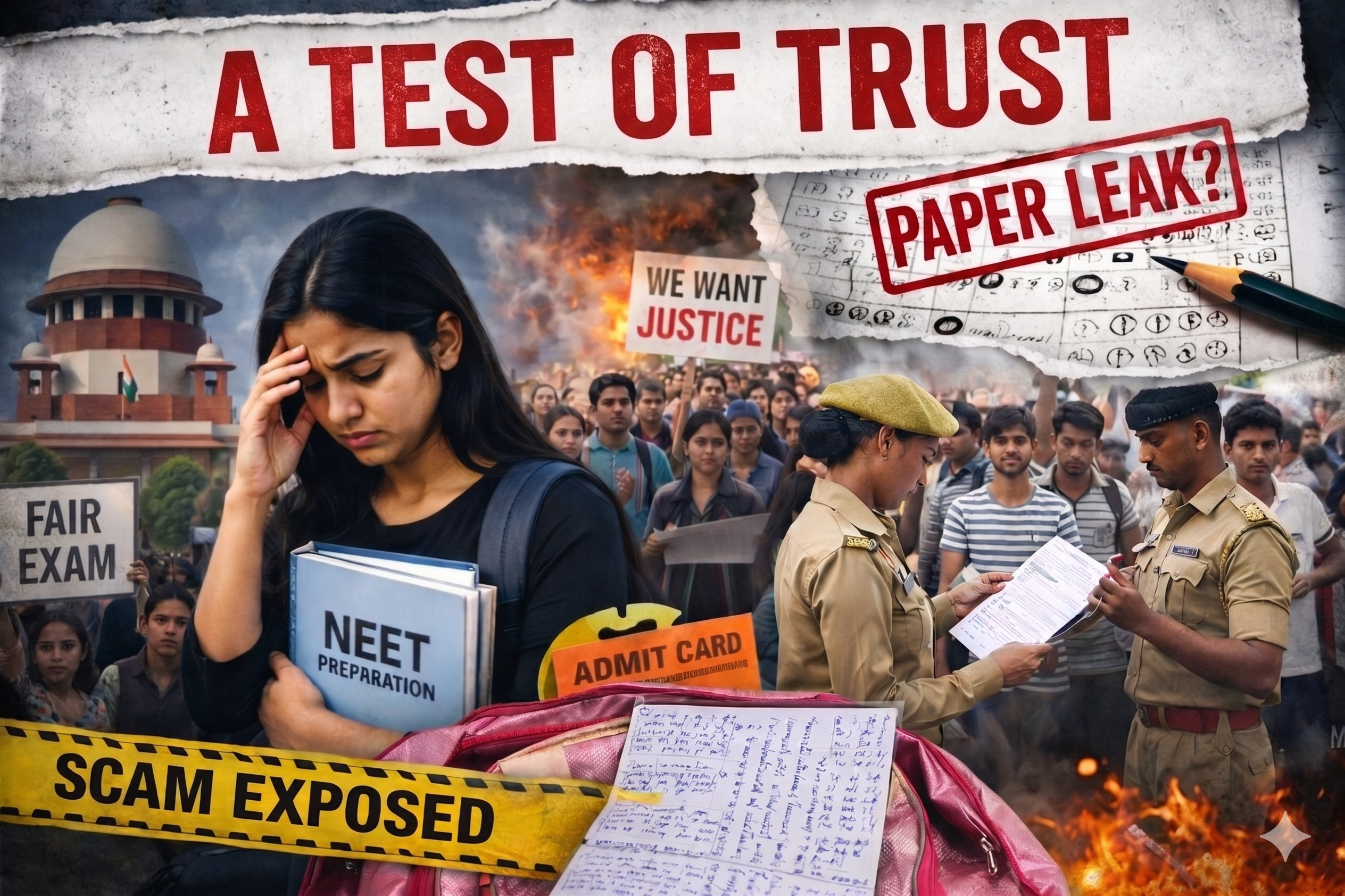
From State-Level Corruption in Medical Entrance Tests, the Malaise Has Reached the National Level
Over a decade ago, in 2013, the state of Madhya Pradesh was rocked by the VYAPAM scam. The acronym VYAPAM stands for Vyavsayik Pariksha Mandal (the Madhya Pradesh Professional Examination Board, or MPPEB). This was a fraud that hit the headlines, dealing a big blow to the credibility of entrance examinations for professional colleges in the state. The main highlights of the scandal were:
Irregularities were discovered in the Pre-Medical Test (PMT) conducted by VYAPAM.
It came to light that the scam had been going on for several years.
The scam involved a number of middlemen, candidates, and officials who colluded to manipulate exam results, facilitate impersonation, and secure admission to government medical colleges by unfair means.
High-profile arrests — The investigation led to the arrest of several high-profile individuals, including politicians, government officials, and education professionals. A few political leaders and bureaucrats were also named as accused.
The extent of the scam was vast; thousands of candidates were part of the irregularities.
Mysterious deaths and speculations — The Vyapam scam gained notoriety for a number of mysterious deaths among the accused, witnesses, and whistleblowers. The circumstances surrounding these raised concerns and controversies.
CBI and Special Task Force (STF) investigation — The scam was investigated by several agencies, including the CBI and STF, leading to arrests, charge sheets, and court cases.

Convictions — A number of individuals were convicted for their roles, while many were acquitted due to lack of evidence.
A large number of mysterious deaths among witnesses and whistleblowers might have silenced many who would otherwise have come forth to testify. This raises genuine concerns that many key players may have been acquitted.
Institutional Failure and the “Shadow of 2024”
Just over a decade after the VYAPAM scam in Madhya Pradesh, irregularities in medical entrance manifested at the national level in NEET-UG 2024.
The 2024 NEET-UG controversy represents one of the most significant crises in the history of Indian competitive examinations. For nearly 2.4 million medical aspirants, the exam is a high-stakes gateway to their future; however, the events of 2024 cast a long shadow over the integrity of the National Testing Agency (NTA) and the meritocratic ideals of the nation.
The Genesis of the Controversy
The issue began shortly after the exam was conducted on May 5, 2024. While the NTA initially dismissed social media reports of paper leaks, investigations by the Economic Offences Unit (EOU) in Bihar and raids in Godhra, Gujarat, uncovered evidence of localised malpractices.
In Patna, several individuals were arrested for allegedly receiving the question paper and solved answers a day before the exam for sums ranging from `30 lakh to `50 lakh. Meanwhile, in Gujarat, a deputy superintendent of an exam centre was accused of aiding students by promising to fill in their blank OMR sheets.
Statistical Anomalies and “Impossible” Scores
The situation reached a boiling point when the results were released on June 4, 2024 — the same day as the general election results. Several “red flags” emerged:
Unprecedented Toppers: An astounding 67 students achieved a perfect score of 720/720. In previous years, this number rarely exceeded three or four.
Mathematical Impossibilities: Some candidates received scores of 718 or 719. Given the NEET marking scheme, these scores are mathematically impossible unless “grace marks” are applied.
Localised Clusters: Multiple top-rankers had appeared for the exam at the same centres, notably in Haryana, fuelling suspicions of systemic collusion.
The Government and NTA’s Response
The NTA initially defended the results, attributing the high scores to a “comparatively easier” paper and the awarding of grace marks to 1,563 candidates who suffered “loss of time” during the exam. However, as public outcry and protests intensified, the Union Education Ministry admitted to “institutional failures.”
Key actions taken included:
Re-test: The Supreme Court oversaw a re-exam for the 1,563 students who received grace marks.
CBI Probe: The investigation was handed over to the Central Bureau of Investigation (CBI) to determine the extent of the leak.
Structural Reform: The government removed the NTA Director General and formed a high-level committee, led by former ISRO chairman Dr K. Radhakrishnan, to recommend reforms for the agency.
Legislative Action: The government notified the Public Examinations (Prevention of Unfair Means) Act, 2024, which carries a maximum penalty of 10 years in prison and a `1 crore fine for organised cheating.
AI-assisted CCTV monitoring and 5G signal jammers.
GPS-tracked transportation of question papers with unique watermarks.
Multi-stage biometric verification of all candidates.
Despite these high-tech interventions, the 2026 incident suggests that the vulnerability may lie in the human element of the supply chain rather than in digital security. The fact that a “guess paper” could mirror nearly 600 marks’ worth of the exam suggests a systemic breach of the question bank itself, rather than a last-minute leak from an exam centre.
The Circumstances of the 2026 Breach
The recent developments surrounding NEET-UG 2026 have once again cast a long shadow over India’s medical education system. On May 12, 2026, the NTA took the major step of cancelling the examination conducted on May 3, following substantial evidence of a question paper leak. This decision, affecting nearly 22.8 lakh students, marks a critical failure in the safeguards intended to protect the aspirations of India’s youth.
The scandal originated from findings by the Rajasthan Police Special Operations Group (SOG). Investigators uncovered a handwritten “guess paper” — a PDF document of roughly 150 pages — containing about 410 questions.
The Overlap: Approximately 120 questions (predominantly in the Biology and Chemistry sections) were found to be identical or significantly similar to the actual NEET-UG paper.
The Timeline: Evidence suggests this material began circulating on WhatsApp and encrypted messaging apps as early as 15 to 30 days before the exam.
The Investigation: Traces of the leak led to a network involving a medical student in Kerala and coaching hubs in Sikar, Rajasthan. The document was reportedly sold for sums ranging from `30,000 to `5 lakh.
Socio-Economic and Psychological Impact
For the 22 lakh aspirants, the cancellation is more than a logistical hurdle; it is a profound psychological blow.
The Coaching Economy: Many students from modest backgrounds spend years in coaching hubs like Kota and Sikar, often funded by life savings or loans. A re-examination forces families to bear additional travel and stay costs.
Erosion of Trust: When the primary gateway to a medical career is repeatedly mired in scandal, it creates a “meritocracy crisis.” Honest students begin to feel that the system favours those with the financial means to buy leaked papers rather than those with the dedication to study.
The Way Forward
The government has now referred the matter to the CBI for a comprehensive probe. While a re-test is necessary to maintain the integrity of the medical profession, it remains a “band-aid” solution to a structural wound.
Moving forward, the debate has shifted toward more radical reforms, such as:
Transitioning to Computer-Based Testing (CBT): Moving away from the pen-and-paper format to minimise physical handling of papers.
Decentralisation: Re-evaluating the “one nation, one exam” model to reduce the impact of a single point of failure.
Legal Accountability: Implementing the strictest possible penalties under the new anti-paper leak laws to deter organised “solver gangs.”
 Bottom Line
The 2026 NEET leak is a sobering reminder that technology cannot substitute for institutional integrity. As the country prepares for a re-examination, the focus must remain on ensuring that the future of India’s healthcare is not auctioned off to the highest bidder. Protecting the sanctity of this exam is not just about medical admissions; it is about restoring the faith of an entire generation in the fairness of the Indian state.
(The author is a renowned epidemiologist and Professor Emeritus at D. Y. Patil Medical College, Pune. Having served as an epidemiologist in the armed forces for over two decades, he has ranked in Stanford University’s list of the world’s top 2 per cent of scientists for three consecutive years (2023-25). He has over three decades of experience as a medical teacher. He is Chairperson of the Universal Health Organization, a public health watchdog: uho.org.in)