
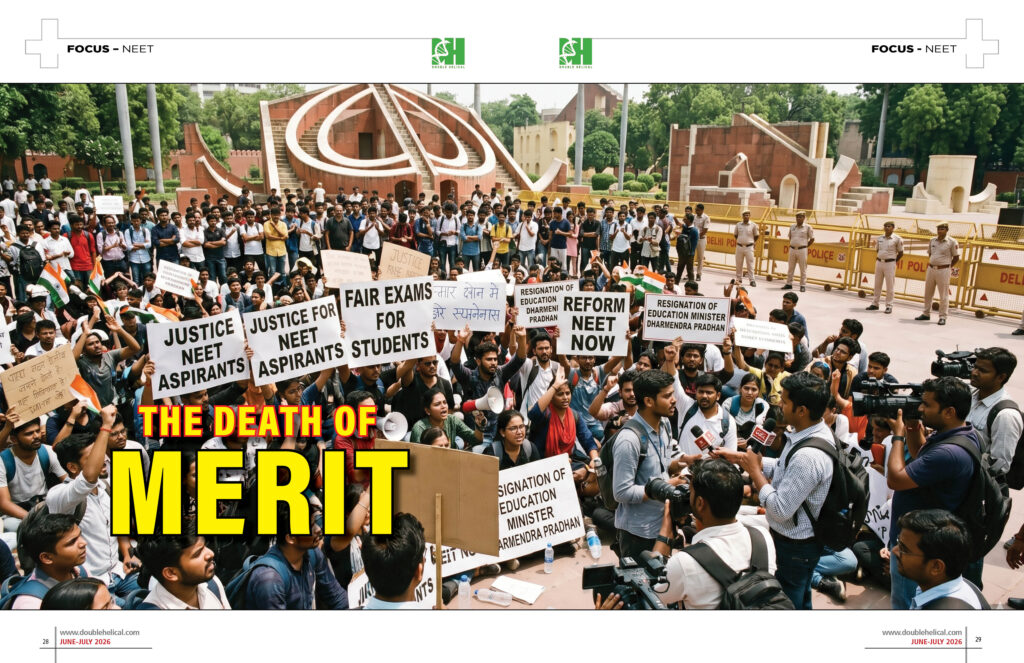
The Death of Merit
 The testing infrastructure of NEET-UG was introduced to clean up medical admissions, but it has achieved the exact opposite. From paper leaks and proxy candidates to zero-percentile cut-offs, systemic rot plagues the nation’s premier medical entrance process.
By Dr Pradeep Kumar Gupta
The admission process to the MBBS course was started through NEET since 2013 on the demand of Hindi-speaking states. At that time, the private medical education business lobby was just emerging, and there were only a few private medical colleges in the Hindi states.
However, the exponential growth of private medical colleges and government medical colleges in North India has obliterated the need for the continuation of NEET. Under the current system, the marks secured in NEET are the sole basis for admissions.
Consequently, many meritorious students with a good score opt out due to the severe monetary constraints imposed by the private medical education system. Vacant seats are then put up for sale in the terminal round of counselling. Affluent students with low marks deliberately wait for the mop-up round, where admission with extremely low scores is officially allowed. The government’s justification for this institutional immorality is to fake the argument of a “deficiency of doctors”. It is this government-politician-education industrialist handshake which gives deep-pocketed aspirants’ families the confidence to supersede merit entirely.
Smart, low-scoring candidates pre-pay capitation fees directly to the college of their choice. Thus, admission is virtually ensured to the highest-paying bidder in private colleges. The percentile requirement in the last round is lowered to the maximum possible extent—dropping down to zero in 2023—to facilitate this institutionalised loot, which is actively assisted and shared by the authorities. Uneducable pupils enter the MBBS degree market while National Medical Commission (NMC) policies successfully exclude talented poor students selectively from private education. Thus, the necessity of securing a good score is completely vanquished.
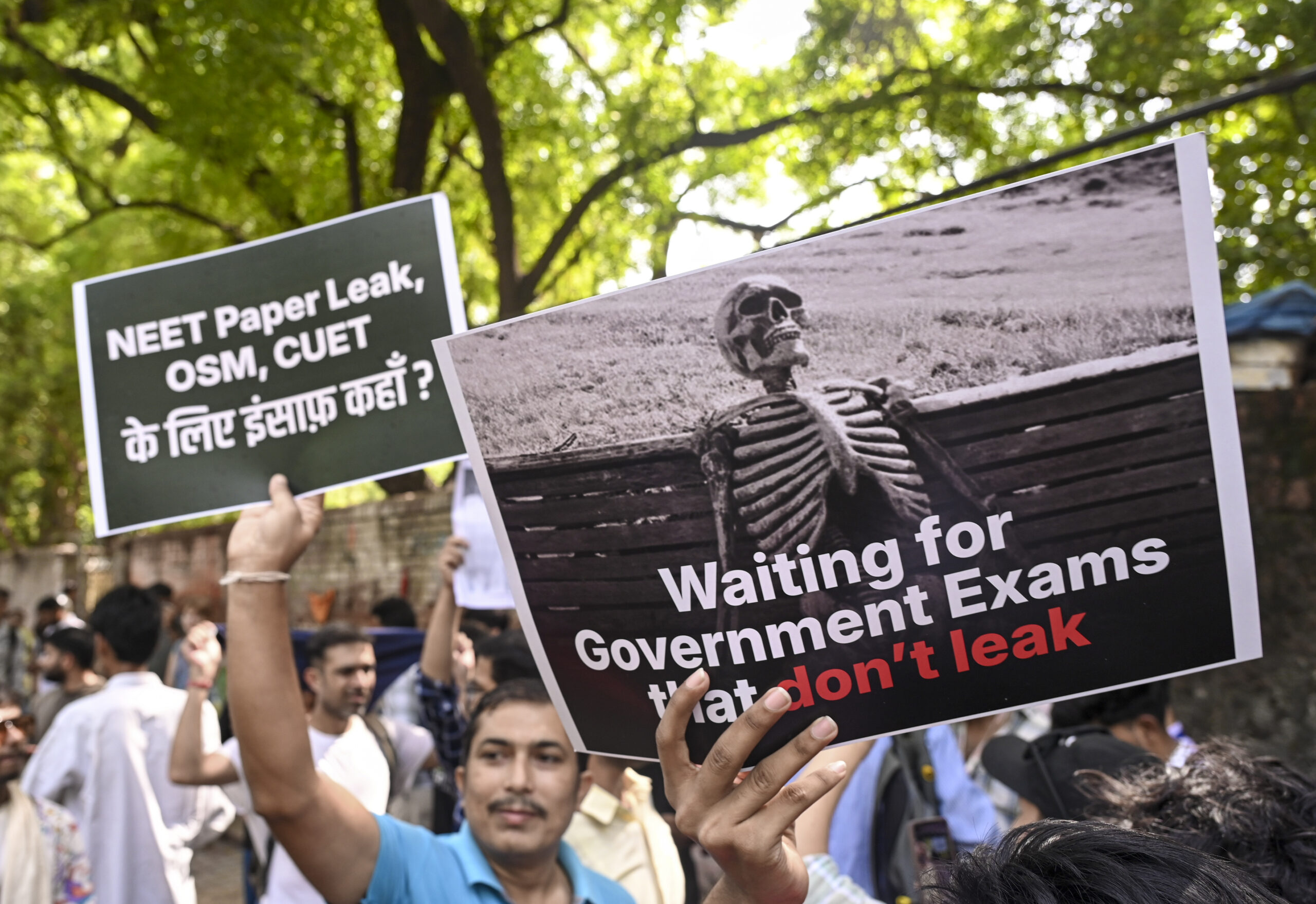
Furthermore, systemic vulnerabilities are so severe that instances have emerged where someone else impersonates the candidate and undertakes NEET, allowing the rich to obtain the final admission, as observed recently in Madhya Pradesh (MP). Paid cheating inside examination centres occurs with absolute impunity. “Pay and get a degree without attending the MBBS course” was available to unqualified practitioners in the pre-NEET era as well, proving that the centralised exam has failed to clean up the system.
As a stark reflection of this ongoing rot, the Central Bureau of Investigation (CBI) arrested two persons in connection with the NEET-UG 2025 scam for allegedly deceiving aspirants and their parents by falsely promising to manipulate exam scores in exchange for `87.5 lakh per candidate (as reported by Harsh Kumar, New Delhi, Updated: Jun 14, 2025 | 3:48 PM, Business Standard).
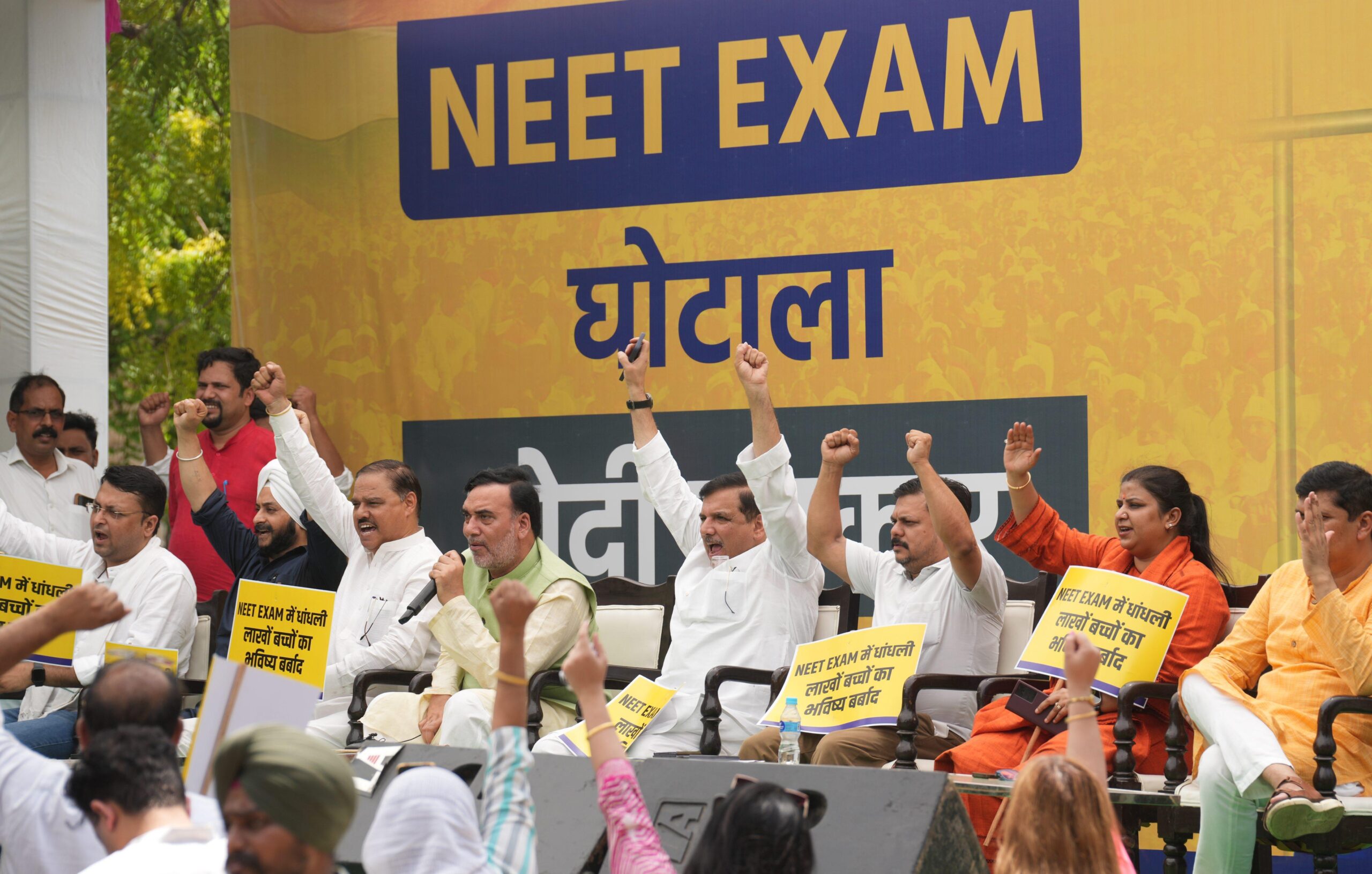 Tragically, the NEET paper leak story of 2024 was repeated in May 2026, when the rich purchased leaked papers for `10 lakh per question paper three days before the examination date. A historical parallel can be drawn from a judicial update: “12 Convicted In Vyapam Pre-Medical Test, 2011 Impersonation Case, were meritorious poor students who tried to finance their medical studies through unfair means” (Free Press Journal, Updated: Saturday, December 27, 2025, 10:59 PM). Yet, the true mastermind crime organiser syndicates remain unknown and are never caught, leaving them free to repeat the same crime over the years.
The catastrophic NEET-UG May 2026 paper leak affected 21 lakh aspirants, most of whom had prepared 8–10 hours a day for two years and spent a minimum of `2 lakh a year on coaching. About 80 lakh parents supported the studies of their children in the hope of a better future for them. Following the debacle, half a dozen despondent students committed suicide in frustration and dejection.
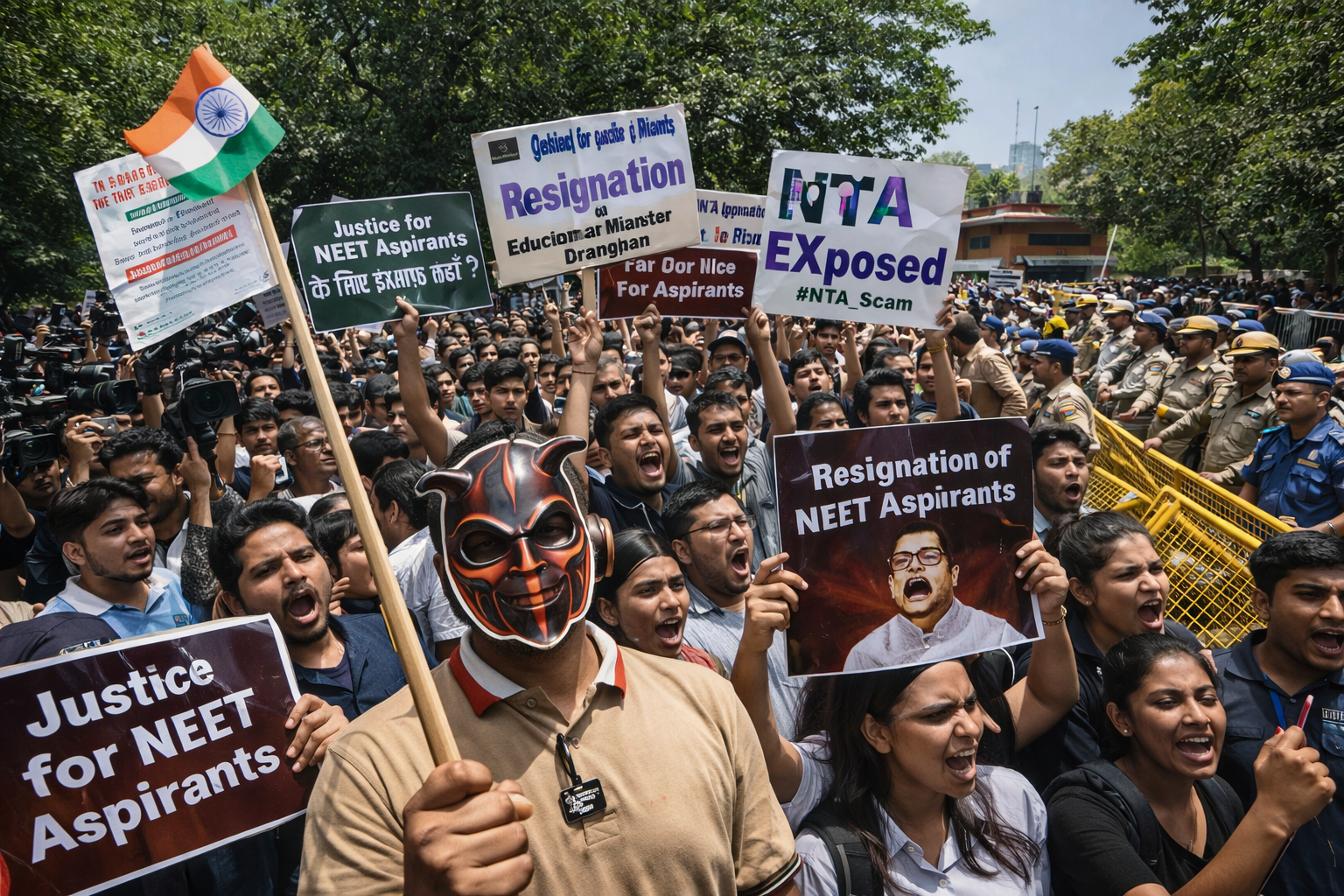
Buying a leaked question paper gives a final push to an aspirant to enter subsidised public medical education. The financial gain of a government fee subsidy justifies parental investment in criminal acts to subvert the system for their children’s benefit. This social normalisation of repeated failures by government testing agencies has generated a mutated public response to this huge talent suppression in India. Under the unrelenting sun at 44°C, the aspirants are left on the road to bear the brutality of the police when they dare to express their frustration. This widespread hopelessness for the future resulted in the unprecedented aggregation of 20 million subscriptions to the “Cockroach Janata Party” digital platform within barely 12 hours of its launch by Gen Zee.
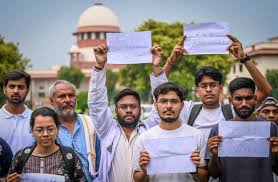 The next date for the Re-NEET-UG-2026 has been announced for 21 June 2026, supposedly involving the armed forces for the conduct of the examination and logistics. Yet, no senior official from the ministry or the executive has accepted responsibility for the original failure.Escaping their constitutional responsibilities, the rulers thought of riding on the chests of the Indian armed forces, who are now compelled to conduct the NEET examination. While the defence forces are known for their high professionalism, credibility, and honesty, the executive and legislature are drumming this as a success of conducting an honest examination, thereby risking the distortion of public faith in our armed forces.
Compounding this crisis, a CBSE 12 qualification with the required 50 per cent marks is a must for appearing in NEET. However, the 17 lakh CBSE Class 12 examination records for 2026 have been affected by technical glitches. This mirrors a past disaster: In 2019, 3.5 lakh students appearing in the Class 12 exams in Telangana faced jeopardised results, causing two dozen student suicides. It is believed that the underlying testing agency for both these exams is the exact same entity operating under different names.
The overall apathy to talent search, the systemic subversion of law and investigations, and government forces and media turning against students have become the ultimate bane of the Indian education system. An unconcerned society merely blinks at this tormenting system.
Are we a nation that is working hard to suppress its talents? Have Indians adopted a “coolie” mentality even seven decades after independence? Are we destined to endure a second-rate education system? Could we ever collectively voice our demands for good education? Do our society and rulers agree with crime-assisted recruitment of semi-competent physicians managing our health and causing death and disease to citizens as the new norm?
 Bilateral Comparative Data Analysis
The following statistical profiles demonstrate how highly volatile and unpredictable raw score requirements have become, causing massive rank inflation that ultimately works against consistent student performance and highlights how the centralised system favours non-performing parameters over structural stability:
These tables compare marks secured, positions obtained, and cut-offs for admission. They show that for securing admissions, raw ranking and absolute marks in NEET do not matter. Instead, the current system favours non-performing or low-performing students via commercial channels.
The Remedy: Restructuring & Structural Reforms
The definitive remedy lies in discouraging uninterested students, reducing the commercial scope for coaching, providing a fair chance for meritorious poor and underprivileged students to enter higher medical studies, reducing the overall cost of medical education, and thoroughly restructuring the medical education system to be merit-friendly.
To achieve this, the NEET-UG national exam should be graded solely as a Preliminary Screening Test (Prelims). Based on the merit secured, the student may be allotted a foundational seat across recognised State Medical Universities spanning MBBS, BDS, Nursing, Physio/Occupational Therapy, Speech Therapy, and Dietician courses. Crucially, after the completion of the first year, all students from these combined medical courses would appear for the State NEET Mains, which would dynamically decide the final list of students permitted for further MBBS continuation. This two-step induction would allow deprived students a second chance to enter MBBS, while uneducable, uninterested, or wealthy students who gained admission through unfair means and money power would be effectively weeded out and eliminated. The toxic influence of direct capital and coaching empires would reduce, giving a long-overdue break to the mad rush and parental aspirations for achieving an MBBS degree at any cost. Parental betting on the wrong horse would thus be minimised.
Furthermore, competitive examination agencies must be brought under the Consumer Protection Act 2019 and the Competition Commission of India Act 2002. An aspirant must be treated legally as a consumer of the service provided by the testing agencies, given that the conduct of an educational test is for education enhancement—unlike a Public Service Commission where a candidate is aspiring for a government job. Consequently, a complete refund of the examination fee and the mandatory award of travelling allowance may be considered in case of cancellations or leaks.
Finally, the prosecution of culprits by special courts must be established for speedy trials. The act of abetting student suicide by the perpetrators of unfair examination leaks could be charged even now under Section 108 of the Bharatiya Nyaya Sanhita (BNS).
Expert Panel Endorsements
The core proposal outlined in this article aligns heavily with external expert evaluations initiated to revamp national test infrastructures:
• The High-Level Mandate: A seven-member expert panel, led by former Indian Space Research Organisation (ISRO) chairman K. Radhakrishnan, was tasked with suggesting comprehensive improvements to the examination process following structural leak fiascos.
• The Multilevel Recommendation: The panel proposed implementing a multiple-stage NEET-UG examination system, closely mirroring the multi-tiered architecture of the Joint Entrance Examination (JEE Advanced) system utilised for engineering admissions.
• The Hybrid Logistics Protocol: The panel strongly recommends a multi-level NEET-UG alongside transitioning all entrance tests to an online format. It also recommends a specialised “hybrid mode” of testing in remote or rural areas where the conduct of fully computer-based entrance exams is logistically or digitally impossible.
The government committee has formally recommended a two-stage examination process. This article builds precisely on that framework, recommending a nationwide preliminary screening to filter the initial pool, while the definitive NEET Mains are held directly under the strict supervision of respective state governments following one year of preliminary, foundational medical studies.
`
(The author is a renowned Radiologist)