
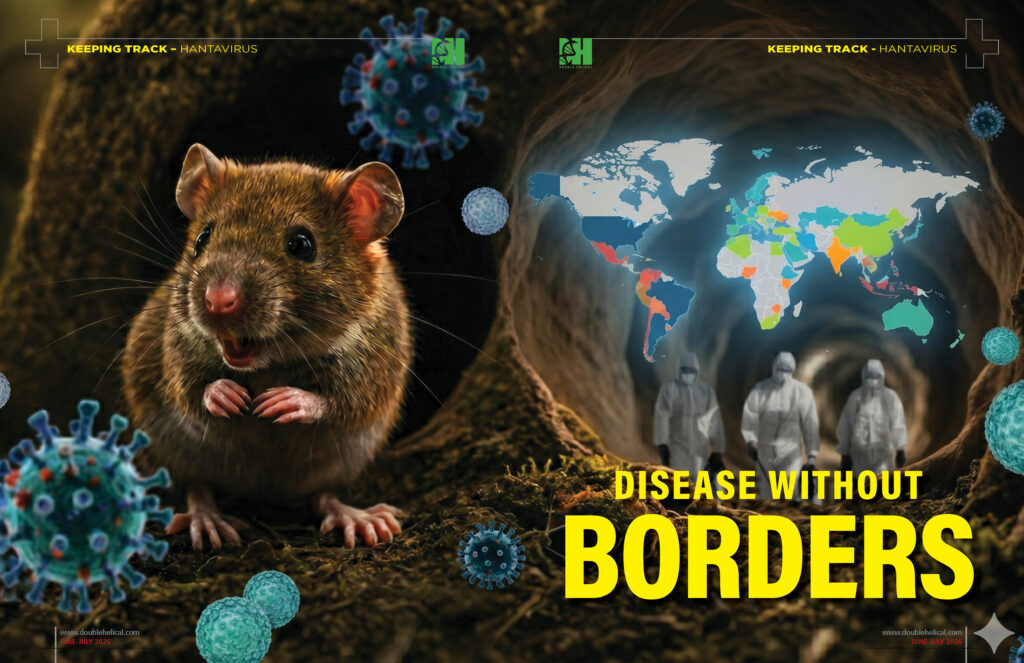
Disease Without Borders
A rare outbreak of Andes virus-linked hantavirus infection aboard a cruise ship has triggered a multi-country public health response.
By Dr Suneela Garg / Dr Madan Gopal / Dr Arvind Garg



On 2 May 2026, a cluster of passengers with severe respiratory illness aboard a cruise ship was reported to the World Health Organization (WHO). At that time, according to the ship operator, 147 passengers and crew were onboard, while 34 passengers and crew members had previously disembarked.
Through the International Health Regulations (2005) [IHR] mechanism, National IHR Focal Points (NFPs) have been informed and are supporting international contact tracing.
 WHO currently assesses the risk posed by this event to the global population as low and will continue to monitor the epidemiological situation and update its risk assessment accordingly. The risk to passengers and crew onboard the ship is considered moderate.
Description of the Situation
On 2 May 2026, WHO received notification from the National IHR Focal Point of the United Kingdom of Great Britain and Northern Ireland (hereafter referred to as the United Kingdom) regarding a cluster of severe acute respiratory illness, including two deaths and one critically ill passenger, aboard a Dutch-flagged cruise ship.
Since the last Disease Outbreak News was published on 4 May, three suspected cases have been confirmed and one additional confirmed case has been reported. As of 8 May, a total of eight cases (six confirmed and two probable cases), including three deaths (two confirmed and one probable), have been reported, representing a case fatality ratio of 38 per cent. All six laboratory-confirmed cases were identified as Andes virus through virus-specific polymerase chain reaction (PCR) testing or sequencing.
Two medical evacuation flights from Cabo Verde, carrying two symptomatic confirmed patients and one previously suspected case, landed in the Netherlands on 6 and 7 May. As of 8 May, four patients remained hospitalised: one in intensive care in Johannesburg, South Africa; two in separate hospitals in the Netherlands; and one in Zurich, Switzerland. The previously suspected case was transferred directly to Germany, where she underwent testing. Both PCR and serology tests were negative for Andes virus; therefore, she is no longer considered a case.
 Contact tracing of passengers who disembarked in St Helena is ongoing. Passengers have been contacted and advised to self-monitor for symptoms. In addition, passengers who travelled on the same flight from St Helena to South Africa as a subsequently confirmed case have also been contacted.
On 6 May, the ship left Cabo Verde and headed for the Canary Islands, Spain, where disembarkation was scheduled to take place.
Further investigations into the potential exposure of the index case and the source of the outbreak are ongoing in collaboration with authorities in Argentina and Chile. The outbreak is being managed through a coordinated international response that includes in-depth epidemiological investigations, case isolation and clinical management, medical evacuations, laboratory testing, and international contact tracing and monitoring.
Case 1
An adult male boarded the ship on 1 April after spending more than three months travelling in Argentina, Chile and Uruguay. He developed symptoms on 6 April and died onboard on 11 April. No microbiological testing was performed. He is considered a probable case.
Case 2
An adult female who was a close contact of Case 1 travelled with him and boarded the ship at the same time. She went ashore at Saint Helena on 24 April with gastrointestinal symptoms. Her condition subsequently deteriorated during a flight to Johannesburg, South Africa, on 25 April. She died on 26 April at a clinic in Johannesburg. On 4 May, she was confirmed to have a hantavirus infection through PCR testing.
Case 3
An adult male developed symptoms on 24 April. He was disembarked and medically evacuated from Ascension Island on 27 April and is currently hospitalised in an Intensive Care Unit (ICU) in Johannesburg, South Africa. PCR testing confirmed hantavirus infection on 2 May, while sequencing subsequently confirmed Andes virus infection.
Case 4
An adult female developed symptoms, including fever and general malaise, on 28 April and later presented with pneumonia. She died on 2 May. A post-mortem sample was collected and transported to the Netherlands with the evacuated patients, where Andes virus infection was confirmed.
Case 5
An adult male serving as the ship’s doctor reported the onset of symptoms on 30 April, including fever, fatigue, myalgia and mild respiratory symptoms. His samples tested positive for Andes virus by PCR on 6 May. The patient was medically evacuated to the Netherlands on 6 May and remains stable in isolation.
Case 6
An adult male employed as a ship guide reported the onset of symptoms on 27 April, with mild respiratory and gastrointestinal manifestations. Laboratory samples confirmed PCR positivity for Andes virus on 6 May. He was medically evacuated to the Netherlands on 7 May and remains stable in isolation.
Case 7
An adult male disembarked in St Helena on 22 April and returned to Switzerland on 27–28 April via South Africa and Qatar. He developed symptoms on 1 May after arriving in Switzerland, where he immediately self-isolated and notified local public health authorities. He is currently hospitalised and remains in isolation. His samples tested positive for Andes virus by PCR on 5 May.
Case 8
An adult male disembarked in Tristan da Cunha on 14 April. He developed diarrhoea on 28 April, followed by fever two days later. He remains stable and in isolation. Pending laboratory confirmation, he continues to be classified as a probable case.
One individual previously reported as a suspected case has now been reclassified as a non-case after testing negative for Andes virus by both PCR and serology. Nevertheless, monitoring will continue until the end of the incubation period following the individual’s last known exposure.
 Operational Outbreak Case Definitions
Suspected Case
Anyone who shared or visited a conveyance where there has been a confirmed or probable ANDV case and who presents with acute symptoms, or a history of symptoms, compatible with ANDV infection, including fever (38°C or above), myalgia, chills, acute gastrointestinal symptoms (such as nausea, vomiting, diarrhoea or abdominal pain), or acute respiratory symptoms (including cough, shortness of breath, chest pain or difficulty breathing).
Probable Case
A person with signs and symptoms consistent with those of a suspected case, who has been evaluated by a healthcare professional, has a known epidemiological link with a confirmed or probable ANDV case, and for whom laboratory testing has not been conducted.
Confirmed Case
A person with laboratory confirmation of ANDV infection through RT-PCR or serological testing.
Non-case
A suspected or probable case who tests negative for ANDV by RT-PCR or serology.
Individuals classified as non-cases who subsequently develop symptoms consistent with the suspected case definition within the maximum incubation period following their last exposure to a probable or confirmed case should be retested and reclassified, as appropriate.
Based on currently available information, the working hypothesis is that Case 1 most likely acquired the infection prior to boarding the ship through environmental exposure during activities undertaken in Argentina. Investigations are ongoing to reconstruct the full itinerary of his travels and identify potential exposure factors.
Current evidence suggests subsequent human-to-human transmission onboard the vessel, based on documented epidemiological links between several subsequent cases and Case 1 during his illness, as well as the timing of symptom onset, which is consistent with previously documented incubation periods for ANDV. However, ongoing epidemiological investigations and genomic sequencing studies are expected to provide a clearer understanding of transmission pathways and exposure sources.
Epidemiology
Hantavirus cardiopulmonary syndrome (HCPS), also known as hantavirus pulmonary syndrome (HPS), is a zoonotic viral respiratory disease caused by hantaviruses belonging to the genus Orthohantavirus, family Hantaviridae, and order Bunyavirales.
More than 20 viral species have been identified within this genus. In the Americas, Sin Nombre virus is the predominant cause of HPS in North America, while Orthohantavirus andesense is responsible for most cases in South America.
Hantaviruses circulating in Europe and Asia are primarily associated with haemorrhagic fever with renal syndrome (HFRS), a disease that mainly affects the kidneys and blood vessels. Human-to-human transmission has not been documented for these strains.
Human hantavirus infection is primarily acquired through contact with the urine, faeces or saliva of infected rodents, or through exposure to contaminated surfaces. Infection commonly occurs during activities such as cleaning rodent-infested buildings, although routine activities in heavily infested environments may also result in exposure.
Human cases are most frequently reported in rural environments, including forests, agricultural fields and farms, where rodent populations are abundant and opportunities for exposure are greater.
HPS is characterised by headache, dizziness, chills, fever, myalgia, and gastrointestinal symptoms such as nausea, vomiting, diarrhoea and abdominal pain, followed by the sudden onset of respiratory distress and hypotension.
Symptoms typically develop one to six weeks after exposure to the virus. However, they may appear as early as one week or as late as eight weeks following infection.
Hantavirus infections remain relatively uncommon worldwide. In 2025, eight countries in the Region of the Americas reported 229 cases and 59 deaths, representing a case fatality rate (CFR) of 25.7 per cent. In the European Region, 1,885 hantavirus infections were reported in 2023 (0.4 cases per 100,000 population), marking the lowest rate recorded between 2019 and 2023.
In East Asia, particularly China and the Republic of Korea, hantavirus-associated haemorrhagic fever with renal syndrome continues to account for many thousands of cases annually, although incidence has declined substantially in recent decades.
Hantavirus infections are associated with case fatality rates ranging from less than 1 per cent to 15 per cent in Asia and Europe, and up to 50 per cent in the Americas.
While there are currently no licensed treatments or vaccines for hantavirus infections, early supportive care and prompt referral to a healthcare facility with intensive care capabilities can significantly improve patient outcomes. Environmental and ecological factors that influence rodent populations may affect disease transmission patterns. Because hantavirus reservoirs are wild rodents, infection may occur whenever individuals come into contact with rodent habitats.
Although uncommon, limited human-to-human transmission of HPS caused by Andes virus has been documented, particularly among individuals with close and prolonged exposure to infected patients. Secondary infections among healthcare workers have also been reported, although such occurrences remain rare.
Available evidence suggests that secondary transmission is most likely during the early phase of illness, when viral shedding may be greatest. However, knowledge remains limited because outbreaks involving confirmed human-to-human transmission of hantavirus infection are exceedingly uncommon.
Public Health Response
Authorities from States Parties involved in managing the event to date—Argentina, Cabo Verde, Chile, Germany, the Netherlands, South Africa, Spain, Switzerland and the United Kingdom—together with WHO and partner organisations, have initiated a coordinated response comprising the following measures:
• WHO has maintained continuous engagement with the National IHR Focal Points of Argentina, Cabo Verde, Chile, Germany, the Netherlands, South Africa, Spain, Switzerland and the United Kingdom to facilitate timely information-sharing and coordination of response activities. International contact tracing involving multiple partners remains ongoing.
Passengers onboard the vessel have been advised to practise physical distancing and remain in their cabins whenever possible.
• One expert from WHO and one from the European Centre for Disease Prevention and Control (ECDC) have been deployed onboard the ship to provide public health guidance and technical support to passengers and crew during the voyage.
• Epidemiological investigations are continuing to identify the source of exposure and clarify transmission pathways.
• WHO has shared information regarding the event, including technical guidance on hantavirus management onboard ships, a technical note covering disembarkation procedures and the onward management of passengers and crew, guidance on the management of contacts of Andes virus cases, its rapid risk assessment, case investigation forms, and details regarding primers and probes for Andes virus detection. These materials have been disseminated through WHO’s secure Event Information Site for National IHR Focal Points to support national response efforts.
• The National IHR Focal Points of affected countries have exchanged passenger and crew manifests with their counterparts in the respective countries of nationality. International contact-tracing activities coordinated through the IHR mechanism remain ongoing.
• The National IHR Focal Point of Argentina requested and received information relating to the first two cases in order to reconstruct their travel itinerary within the Southern Cone region of the Americas and assess potential exposure to hantavirus. Argentina also shared its National Hantavirus Epidemiological Circular outlining updated surveillance and management standards for hantavirus infection.
• In accordance with the Working Arrangement between the WHO Emergency Medical Team (EMT) Secretariat and the European Union Emergency Response Coordination Centre (ERCC), formal discussions have been initiated to support both the clinical management and medical evacuation of symptomatic passengers. The EU Health Task Force (EUHTF) has also been activated to provide assistance.
• WHO has facilitated logistical support, including the provision of sample collection materials and assistance with the shipment of specimens to the Institut Pasteur de Dakar, Senegal.
• Laboratory confirmation of hantavirus infection has been undertaken by the National Institute for Communicable Diseases (NICD) in South Africa. Identification of Andes virus was subsequently confirmed through genomic sequencing at NICD and virus-specific PCR testing at Geneva University Hospitals, Switzerland.
• WHO has further supported collaboration among laboratories in Senegal, the United Kingdom, the Netherlands and Argentina to facilitate timely testing. Additional investigations, including serology, sequencing and metagenomic analyses, are currently underway.
• WHO has developed a range of technical guidance documents to assist affected countries, covering outbreak management onboard the vessel, case investigation procedures, disembarkation protocols, and the management of returning passengers and crew.
• Risk communication activities are being coordinated to ensure the dissemination of regular, timely and evidence-based information. WHO has activated three-level organisational coordination and continues to support national authorities in implementing risk-based and evidence-informed public health measures in accordance with the provisions of the IHR and relevant WHO technical guidance.
WHO Risk Assessment
WHO currently assesses the public health risk associated with this event as moderate for passengers and crew linked to the cruise ship and low at the global level for the following reasons:
• The disease may be associated with a high case fatality ratio, reaching 40–50 per cent, particularly among older adults and individuals with underlying medical conditions. The average age of passengers onboard the vessel is approximately 65 years.
• Andes virus has demonstrated limited human-to-human transmission in previous outbreaks. Such transmission has generally occurred among close contacts, particularly within household settings, and usually requires prolonged exposure. Transmission can often be interrupted through early detection, isolation of cases, clinical management and comprehensive contact tracing. However, the cruise ship environment presents unique challenges because of shared accommodation, enclosed indoor settings, prolonged exposure periods and frequent interpersonal interaction, all of which may increase opportunities for transmission.
• Investigations into the travel history and possible exposures of the index case within the Southern Cone region of the Americas remain ongoing. Preliminary findings suggest potential exposure to infected rodents during bird-watching activities. Genomic sequencing studies are also underway to compare the outbreak strain with Andes virus strains circulating in Argentina, Chile and Uruguay, where the disease is endemic.
• Additional cases may still occur among individuals who were exposed before containment measures were implemented. Nevertheless, current response activities—including rapid identification and isolation of suspected cases, comprehensive contact tracing, and active monitoring of contacts—are expected to reduce the likelihood of further spread.
• Because there is currently no specific antiviral therapy for HPS, suspected cases require prompt transfer to appropriately equipped healthcare facilities, including intensive care units where available, for close monitoring and supportive management. Such measures are critical to improving survival outcomes. Under the circumstances of this outbreak, rapid transfer to mainland healthcare facilities may present operational challenges.
More detailed epidemiological, clinical and laboratory investigations are required to refine the current risk assessment and guide subsequent response measures.