
Beyond the Vaccine
 While vaccination is a vital tool to eliminate the virus, improving baseline nutritional status is an essential factor in reducing child mortality.
By Dr Amitav Banerjee
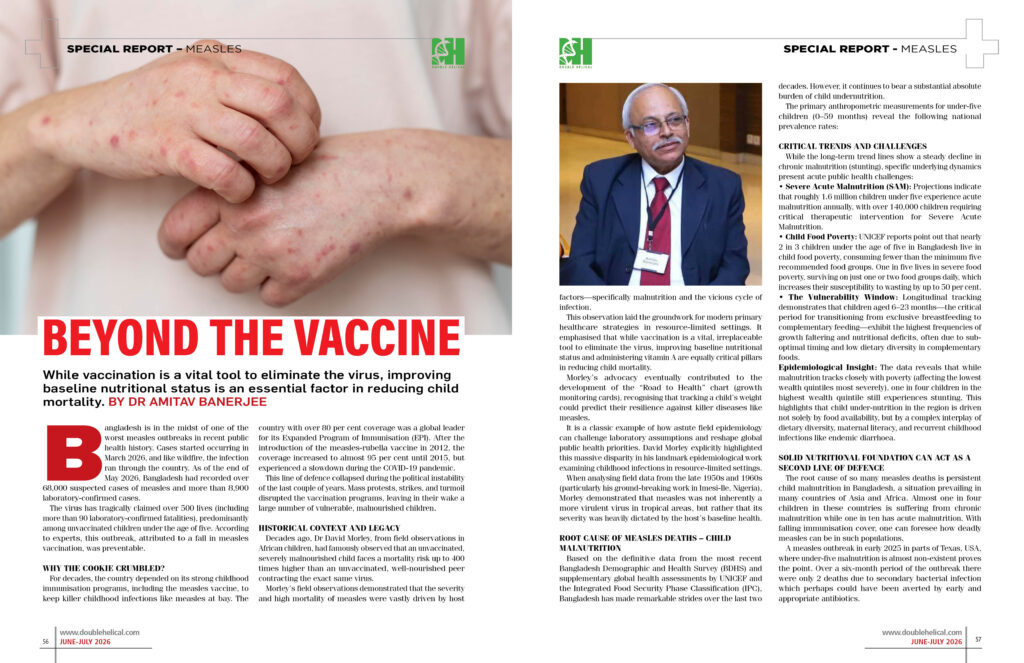
Bangladesh is in the midst of one of the worst measles outbreaks in recent public health history. Cases started occurring in March 2026, and like wildfire, the infection ran through the country. As of the end of May 2026, Bangladesh had recorded over 68,000 suspected cases of measles and more than 8,900 laboratory-confirmed cases.
The virus has tragically claimed over 500 lives (including more than 90 laboratory-confirmed fatalities), predominantly among unvaccinated children under the age of five. According to experts, this outbreak, attributed to a fall in measles vaccination, was preventable.
Why the cookie crumbled?
For decades, the country depended on its strong childhood immunisation programs, including the measles vaccine, to keep killer childhood infections like measles at bay. The country with over 80 per cent coverage was a global leader for its Expanded Program of Immunisation (EPI). After the introduction of the measles-rubella vaccine in 2012, the coverage increased to almost 95 per cent until 2015, but experienced a slowdown during the COVID-19 pandemic.
This line of defence collapsed during the political instability of the last couple of years. Mass protests, strikes, and turmoil disrupted the vaccination programs, leaving in their wake a large number of vulnerable, malnourished children.
 Historical Context and Legacy
Decades ago, Dr David Morley, from field observations in African children, had famously observed that an unvaccinated, severely malnourished child faces a mortality risk up to 400 times higher than an unvaccinated, well-nourished peer contracting the exact same virus.
Morley’s field observations demonstrated that the severity and high mortality of measles were vastly driven by host factors—specifically malnutrition and the vicious cycle of infection.
This observation laid the groundwork for modern primary healthcare strategies in resource-limited settings. It emphasised that while vaccination is a vital, irreplaceable tool to eliminate the virus, improving baseline nutritional status and administering vitamin A are equally critical pillars in reducing child mortality.
Morley’s advocacy eventually contributed to the development of the “Road to Health” chart (growth monitoring cards), recognising that tracking a child’s weight could predict their resilience against killer diseases like measles.
It is a classic example of how astute field epidemiology can challenge laboratory assumptions and reshape global public health priorities. David Morley explicitly highlighted this massive disparity in his landmark epidemiological work examining childhood infections in resource-limited settings.
When analysing field data from the late 1950s and 1960s (particularly his ground-breaking work in Imesi-Ile, Nigeria), Morley demonstrated that measles was not inherently a more virulent virus in tropical areas, but rather that its severity was heavily dictated by the host’s baseline health.
Root cause of measles deaths – child malnutrition
Based on the definitive data from the most recent Bangladesh Demographic and Health Survey (BDHS) and supplementary global health assessments by UNICEF and the Integrated Food Security Phase Classification (IPC), Bangladesh has made remarkable strides over the last two decades. However, it continues to bear a substantial absolute burden of child undernutrition.
The primary anthropometric measurements for under-five children (0–59 months) reveal the following national prevalence rates:
Critical Trends and Challenges
While the long-term trend lines show a steady decline in chronic malnutrition (stunting), specific underlying dynamics present acute public health challenges:
• Severe Acute Malnutrition (SAM): Projections indicate that roughly 1.6 million children under five experience acute malnutrition annually, with over 140,000 children requiring critical therapeutic intervention for Severe Acute Malnutrition.
• Child Food Poverty: UNICEF reports point out that nearly 2 in 3 children under the age of five in Bangladesh live in child food poverty, consuming fewer than the minimum five recommended food groups. One in five lives in severe food poverty, surviving on just one or two food groups daily, which increases their susceptibility to wasting by up to 50 per cent.
• The Vulnerability Window: Longitudinal tracking demonstrates that children aged 6–23 months—the critical period for transitioning from exclusive breastfeeding to complementary feeding—exhibit the highest frequencies of growth faltering and nutritional deficits, often due to sub-optimal timing and low dietary diversity in complementary foods.
Epidemiological Insight: The data reveals that while malnutrition tracks closely with poverty (affecting the lowest wealth quintiles most severely), one in four children in the highest wealth quintile still experiences stunting. This highlights that child under-nutrition in the region is driven not solely by food availability, but by a complex interplay of dietary diversity, maternal literacy, and recurrent childhood infections like endemic diarrhoea.
Solid nutritional foundation can act as a second line of defence
The root cause of so many measles deaths is persistent child malnutrition in Bangladesh, a situation prevailing in many countries of Asia and Africa. Almost one in four children in these countries is suffering from chronic malnutrition while one in ten has acute malnutrition. With falling immunisation cover, one can foresee how deadly measles can be in such populations.
A measles outbreak in early 2025 in parts of Texas, USA, where under-five malnutrition is almost non-existent proves the point. Over a six-month period of the outbreak there were only 2 deaths due to secondary bacterial infection which perhaps could have been averted by early and appropriate antibiotics.
The ongoing measles epidemic in Bangladesh is heavily intersecting with child malnutrition, which global health agencies identify as a primary risk factor driving the high rates of severe complications and mortality.
According to reports from the World Health Organization (WHO), UNICEF, and the Directorate General of Health Services (DGHS) tracking the outbreak, the situation presents a classic textbook example of nutritional synergy during a major vaccine-preventable disease crisis.
The Way Forward
While vaccination coverage for childhood paediatric priorities like measles is important, a solid foundation by good nutrition in the first five years of life, including the antenatal period, can provide a reliable second line of defence during periods of disruption in immunisation programs. As David Morley stated eliminating under-five malnutrition can reduce measles mortality by up to 400-fold even without vaccination.
So, depending solely on measles vaccination is akin to giving a coat of plaster and paint to a building with a poor foundation which can come down during a heavy monsoon.
Besides vulnerability to infections like measles, early-life malnutrition also pre-disposes individuals to non-communicable diseases in adulthood. Non-communicable diseases like diabetes and high blood pressure are not solely the result of adult lifestyle choices. For an individual who suffered early-life malnutrition, their biological threshold for handling a standard or high-calorie diet is significantly lower because their organs get structurally and epigenetically optimised for an entirely different, scarcer world. This is known as the Barker Hypothesis (Foetal and Infant Origins of Adult Disease).
A strong nutritional foundation during the first five years of life is like a strong foundation of a building. This structure can withstand not only heavy monsoons but also other vagaries of nature such as cyclones or mild to moderate earthquakes. Similarly, the abolition of malnutrition among under-fives will not only prevent mortality from severe infections like measles but also shield the individual from many health risks throughout life.
(The Author is a renowned epidemiologist, and Professor Emeritus at D Y Patil Medical College, Pune. Having served as an epidemiologist in the armed forces for over two decades, he ranked in Stanford University’s list of the world’s top 2 per cent scientists for three consecutive years (2023-25). Currently, he is the Chairperson of the Universal Health Organization (uho.org.in), a public health watchdog)