
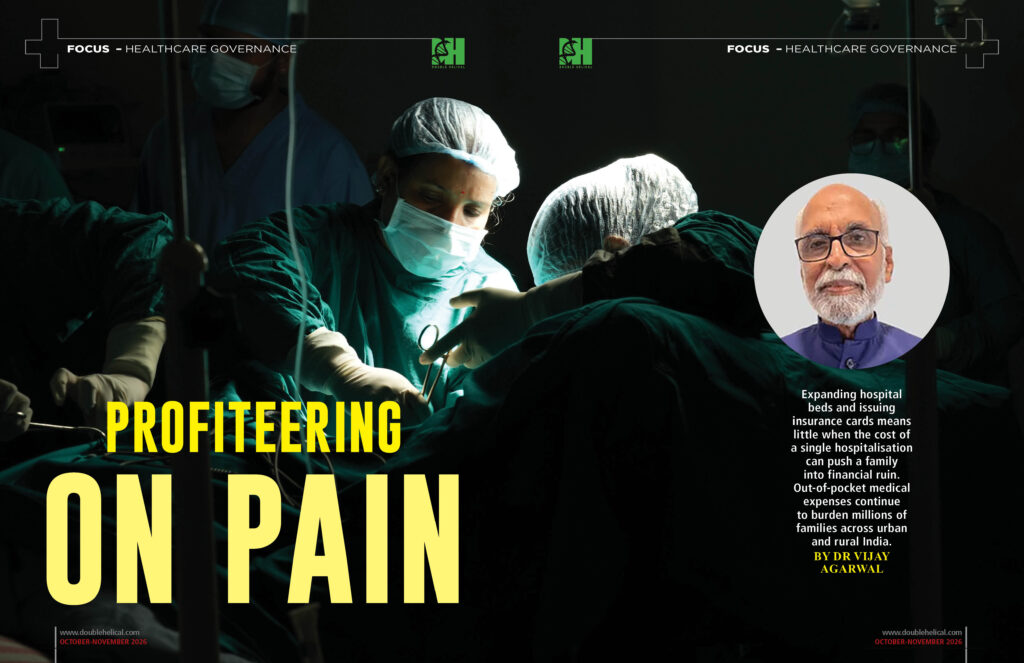
Profiteering on Pain
 Expanding hospital beds and issuing insurance cards means little when the cost of a single hospitalisation can push a family into financial ruin. Out-of-pocket medical expenses continue to burden millions of families across urban and rural India.
By Dr Vijay Agarwal
In India’s sprawling medical landscape, falling ill remains a fast route to financial ruin. Corporate hospitals cater to affluent patients and global tourists. Meanwhile, millions of citizens remain trapped between under-resourced public facilities and an unregulated, expensive private sector. The Parliamentary Standing Committee on Health and Family Welfare presented its 176th Report in August 2026. Titled Affordability and Accessibility of Healthcare Facilities in Public and Private Sector, the report examines healthcare costs, quality, regulation, and regional disparities. It also evaluates insurance coverage, medicines, diagnostics, digital health, human resources, and Ayush integration.
India has expanded public infrastructure, medical education, and digital health platforms. Telemedicine and affordable medicines have also seen growth. However, out-of-pocket expenditure remains high. Spending is especially high for medicines, diagnostics, outpatient care, chronic diseases, emergency care, and private hospitalisation. The Committee stresses that real reform demands a balanced model. India needs stronger public health infrastructure and better-regulated private care. It requires wider insurance coverage, transparent pricing, and stronger primary care. The country must also increase public health spending as a share of GDP, improve workforce planning, lower device costs, and deliver patient-centric care.
Key Findings
1. Public sector remains the backbone, but is under-capacitated
Public healthcare is essential for rural, poor, and vulnerable populations because it offers free or low-cost care. However, public facilities suffer from severe overcrowding and long waiting times. They face specialist shortages and inadequate infrastructure at PHC, CHC, and district-hospital levels. Gaps in diagnostics and essential medicines also reduce public confidence in these centres. The Committee stresses that improving public-sector quality is the most sustainable way to lower household health spending.
2. Private sector is essential but insufficiently regulated
The private sector provides over 60% of inpatient care and around 70% of outpatient care in India. It offers advanced care, better amenities, shorter waiting times, and specialised urban services. However, major concerns persist regarding high and unpredictable costs. Patients face arbitrary billing, over-investigation, and non-standard treatment packages. Facilities remain heavily concentrated in urban areas. Furthermore, small clinics, nursing homes, and diagnostic centres face weak regulation, and the Clinical Establishments Act sees uneven enforcement. The Committee recommends stronger regulation, transparent tariffs, standard treatment guidelines, and package-rate discipline.
3. Out-of-pocket expenditure is still a major burden
Although out-of-pocket expenditure has declined over the years, it remains significant. Major drivers include medicines, diagnostics, outpatient care, consultation fees, and consumables. Costs for ICU care, emergency services, chronic disease management, private hospitalisation, and rural patient travel further add to the burden. The report stresses that insurance schemes remain hospitalisation-heavy. They fail to adequately cover outpatient visits and recurring medicine expenses.
4. Health spending needs to rise
Government Health Expenditure stood at around 1.43% of GDP in 2022–23. This remains well below the National Health Policy target of 2.5% of GDP. The Committee recommends a binding, time-bound roadmap to reach 2.5%. It urges ring-fenced multi-year health allocations and annual reporting to Parliament. It also calls for a minimum threshold for health spending in total government expenditure and protection against post-pandemic budget cuts.
5. Insurance coverage has expanded, but gaps remain
AB-PMJAY has provided financial protection to vulnerable populations and extended coverage to citizens aged 70+. Nevertheless, major gaps persist. The “missing middle” remains under-protected, while informal and gig workers need better coverage. Outpatient costs receive poor coverage, and claim delays discourage hospital participation. Additionally, package rates do not reflect real costs, and fraud remains a concern. The Committee recommends low-cost standardised insurance products, faster claims settlement, package-rate revisions, and digital fraud detection.
6. Rural, tribal, hilly, and underserved regions need priority
The report highlights persistent geographic inequities across regions. Rural and tribal areas face specialist shortages, long travel distances, and poor emergency access. Many sub-centres lack buildings, and diagnostic capacity remains weak. Meanwhile, private hospitals concentrate heavily in urban areas, limiting rural access to tertiary care. The Committee recommends targeted investment, rural service incentives, mobile medical units, telemedicine, and digital referrals. It also advocates incentives for private investment in tier-2, tier-3, aspirational, tribal, and remote districts.
7. Digital health is central to access and continuity of care
The Committee strongly supports the Ayushman Bharat Digital Mission (ABDM) and ABHA IDs. It endorses the Health Facility Registry, eSanjeevani, U-WIN, digital health records, e-prescriptions, and teleconsultations. It also highlights clinical decision support, remote patient monitoring, and AI-enabled screening. The report recommends mandatory ABDM compliance for public facilities and PMJAY-empanelled private hospitals.
8. Medicines and diagnostics require stronger affordability controls
Medicines remain a primary source of household health expenditure. Key recommendations include guaranteeing essential medicines at public facilities and expanding Jan Aushadhi Kendras. Jan Aushadhi and AMRIT pharmacies should co-locate inside hospitals. Regulators must enforce generic prescribing and monitor drug availability through DVDMS. The NPPA should take stronger action on trade margins and enforce price controls on essential medicines and devices. Fast-track mechanisms are also necessary to prevent shortages.
9. Human resources are a critical bottleneck
India has expanded MBBS and PG seats, medical colleges, AIIMS, and nursing colleges. However, training capacity alone is insufficient. Critical requirements include a clear rural deployment strategy and uniform pay scales for specialists. ASHA and NHM workers require timely remuneration. Systems also need flexible hiring for super-specialists, expansion of the allied health workforce, a national workforce registry, better faculty availability, and a dedicated hospital administrator cadre.
10. Ayush integration is seen as part of affordability and preventive care
The Committee supports integrating Ayush with mainstream public healthcare. This requires co-locating Ayush services at PHCs, CHCs, and district hospitals. It also involves Ayushman Arogya Mandirs, standard treatment guidelines, and broader insurance coverage. Essential Ayush medicines require price controls, alongside rigorous scientific validation of Ayush interventions.
Stakeholder-Wise Segments
Policymakers and Government Ministries
Public health expenditure remains below the 2.5% GDP target. Health budgets fluctuate after emergencies, and public infrastructure remains uneven. Private costs face inadequate regulation, while insurance fails to fully protect households. Key actions include creating a binding roadmap to raise health spending to 2.5% of GDP. Policymakers must ring-fence health allocations through multi-year budgeting. They should strengthen PHCs, CHCs, district hospitals, and medical colleges. Enforcing the Clinical Establishments Act across states is vital.
Authorities must standardise treatment packages and private-sector billing. They should expand PMJAY and design low-cost insurance for the “missing middle.” Financial protection models must include outpatient care and diagnostics. Furthermore, government must accelerate PM-ABHIM and NHM grants, integrate digital health platforms, and build a national emergency referral network. Strategically, the report pushes the government toward universal health coverage through public investment and regulated private participation.
State Governments
States face uneven adoption of national laws and poor sub-centre infrastructure. They suffer from specialist vacancies, delayed fund utilisation, and regional disparities. Recommended measures include adopting and enforcing the Clinical Establishments Act. States must ensure IPHS compliance across facilities using digital dashboards. They must fill CHC specialist vacancies urgently and deploy Finance Commission grants faster.
States should build missing sub-centres and upgrade district hospitals. They need to strengthen urban primary health systems for slums and migrants. Developing telemedicine-linked specialist hubs is essential. Local governments require incentives to invest in elderly and palliative care. Finally, states must accelerate insurance claims processing. States must shift focus from mere scheme implementation to measurable service readiness and accountability.
Public Hospitals and Government Medical Colleges
Public facilities suffer from overcrowding and long wait times. Consultation times are short, bed shortages persist, and diagnostic testing faces delays. Administrative systems also remain weak. Key actions involve expanding bed capacity and recruiting specialists and allied health workers. Institutions should establish dedicated hospital administrator cadres. They must publish key performance indicators, such as wait times, bed occupancy, infection rates, and average stay.
Facilities need to improve digital appointment queues and create step-down care pathways. They should co-locate Jan Aushadhi and AMRIT pharmacies on campus. Strengthening trauma, cancer, geriatric, and palliative care is essential. Hospitals should utilise AI-assisted triage and link internal systems with ABDM and ABHA. Public hospitals must become patient-centric, digitally managed, transparent, and operationally efficient.
Private Hospitals and Healthcare Providers
Private care displays high prices, variable quality, arbitrary billing, and urban concentration. Scheme participation remains low due to poor package rates and claim delays. Recommended actions include publishing transparent tariffs and adopting standard treatment guidelines. Providers should follow standardised package rates and participate in PMJAY. They must accept digital claims via NHCX and avoid over-investigation.
Private chains should expand into tier-2, tier-3, and rural districts. They can use international patient revenue for cross-subsidised care. Allocating beds for government scheme beneficiaries is necessary. Providers must also adopt ABDM-compliant digital records. Private healthcare will remain essential, but it must operate within a regulated, transparent, and equity-oriented framework.
Health Insurers, IRDAI, and NHA
The “missing middle” lacks coverage, while outpatient expenses remain neglected. Claim settlement delays damage provider trust, package rates are outdated, and policy terms remain complex. Insurers must develop low-cost standardised products for informal workers. They should expand coverage beyond hospitalisation to include outpatient, diagnostic, and chronic disease care.
Insurers must periodically revise package rates and utilise NHCX for faster claims. Deploying AI-based fraud detection will reduce losses. Companies should standardise billing documentation, improve grievance redressal, and simplify policy language. Insurance must evolve from basic hospitalisation reimbursement to comprehensive financial protection.
Pharmaceutical Companies, NPPA, and Medical Device Sector
Medicine costs remain a primary driver of out-of-pocket spending. These costs are inflated by high trade margins and drug supply risks. Action items include expanding price regulation for essential medicines and devices. Authorities must continue trade margin rationalisation and monitor raw material costs. Regulators should prevent formulation withdrawals and support domestic manufacturing.
Policy should encourage innovation through carefully designed exemptions. Strengthening MedTech Mitra and HTA mechanisms will support affordable indigenous medical technologies. Sector leaders must support value-based and cost-based pricing models. Quality and packaging standards also require strengthening. India requires both affordable generics and advanced indigenous innovation.
Digital Health, AI, and Health-Tech Stakeholders
Digital systems remain fragmented, ABDM adoption is uneven, and rural facilities lack connectivity. Stakeholders should make ABDM compliance mandatory for public and empanelled private facilities. Systems must link ABHA IDs with health records, referrals, NCD screening, and claims. Expanding eSanjeevani and teleconsultation services is crucial.
Providers should deploy validated AI screening tools for diabetic retinopathy, chest X-rays, oncology, and mental health. AI can also assist in epidemic forecasting. Facilities need live dashboards for ICU beds and emergency occupancy, alongside GIS-based ambulance tracking. AI deployment must remain ethical, validated, and clinically supervised. Digital health serves as the connective tissue of universal healthcare.
Rural, Tribal, Migrant, Elderly, and Vulnerable Populations
Vulnerable groups face long travel distances, poor specialist access, and high medicine costs. They suffer from weak emergency care, chronic disease burdens, and low insurance awareness. Recommendations include strengthening local primary care and expanding mobile medical units. Telemedicine access must improve, and essential medicines and diagnostics must remain free.
Authorities should expand PMJAY senior-citizen coverage and build geriatric and palliative services. Utilizing portable digital health records will aid mobile populations. Tribal belts require stronger sickle-cell screening. Outreach programs must target migrants and the urban poor, while ambulance and referral networks undergo upgrades. The report frames healthcare access fundamentally as a question of equity, geography, and social protection.
Ayush Institutions and Integrative Medicine Stakeholders
Ayush lacks uniform integration into public care. Insurance reimbursement remains uneven, and price controls for Ayush medicines are limited. Key actions include co-locating Ayush facilities in PHCs, CHCs, and district hospitals under a mandatory baseline policy. Stakeholders must develop standard treatment guidelines across Ayush streams.
Insurance benchmark rates require updating, alongside price controls for essential Ayush drugs. Expanding satellite clinics and mobile units is necessary. Public health budgets for Ayush need ring-fenced protection. Scientific validation requires strengthening through ICMR, AIIMS, and research councils. Finally, institutions must train allied Ayush workers and integrate Ayush into preventive NCD care. Ayush can contribute significantly to affordable preventive care if evidence and integration improve.
Patients and Civil Society
Patients suffer from a lack of price transparency and complex insurance terms. High diagnostic bills, long hospital waits, and weak grievance redressal create frustration. Recommended steps include demanding itemised transparent bills. Patients should utilise Jan Aushadhi generic options whenever appropriate. They should verify PMJAY and insurance eligibility.
Adopting digital records, ABHA, and telemedicine will streamline care. Patients must report overcharging or denial of entitled care. They should seek treatment through empanelled hospitals and utilise public bed dashboards. Participating in health screening and advocating for patient rights remains vital. Patients must become informed users, while the system must become easier to navigate.
Priority Themes for CAHO and Quality Stakeholders
Given CAHO’s focus on quality, accreditation, safety, and system improvement, the report’s key themes align with specific opportunities:
1. Standard Treatment Guidelines and Clinical Governance
The report emphasises STGs to reduce unnecessary investigations and irrational treatment variation. STGs also combat overbilling, antibiotic misuse, insurance disputes, and unpredictable costs. CAHO can develop implementation toolkits, audit formats, and training modules for STG adoption.
2. Transparent Pricing and Ethical Billing
The Committee calls for standardised packages, tariff disclosure, and billing transparency. CAHO can create a voluntary “transparent billing and patient financial communication” framework for hospitals.
3. Quality-Linked Affordability
Affordability connects directly to avoiding hospital-acquired infections and excessive lengths of stay. It prevents delayed diagnosis, weak referral systems, inefficient discharge planning, and step-down care deficits. CAHO can promote quality-improvement projects that directly reduce patient costs.
4. Public-Private Partnership Standards
The report supports PPPs in diagnostics, dialysis, specialist care, and underserved districts. CAHO can define quality and safety standards for PPP service delivery.
5. Digital Health Readiness
ABDM compliance, e-prescriptions, digital referrals, and claims exchange are major priorities. CAHO can create hospital readiness assessments for ABDM, NHCX, digital consent, and interoperable records.
6. Patient Experience and Emergency Coordination
The report highlights patient satisfaction, waiting times, service efficiency, and live ICU dashboards. It also emphasises ambulance networks and trauma care expansion. CAHO can develop patient-experience indicators and support emergency-care quality standards alongside inter-facility transfer protocols.
Stakeholder Communication Directives
Government officials must recognise that affordability cannot be achieved by insurance alone. It requires higher public spending, strengthened public facilities, regulated private pricing, and digital accountability. Private hospitals face a future operating environment that demands tariff transparency, standard treatment protocols, ABDM compliance, faster digital claims, and demonstrable value. Public hospitals can restore trust through shorter waits and guaranteed medicine availability. Specialist access, digital queues, performance dashboards, and patient navigation are also essential.
Insurers must expand beyond hospitalisation reimbursement. They must address outpatient, chronic disease, diagnostic, and medicine expenditures. Digital health companies should target ABDM integration, digital referrals, claims automation, AI screening, emergency dashboards, and public-health analytics. Ultimately, patients deserve care that is affordable, nearby, transparent, and digitally portable. Care must protect households against catastrophic expenditure. This creates a strong policy opening for quality-linked affordability, standard protocols, ethical billing, patient safety, and measurable clinical outcomes.
Takeaways
The Parliamentary Committee’s report argues that India’s healthcare challenge is no longer only about building more hospitals or expanding scheme enrolment. The real challenge is making care affordable, accessible, predictable, accountable, and equitable. It calls for a health system where public hospitals are stronger and less overcrowded. Private hospitals must operate with transparency and regulation. Insurance must cover real household risks rather than just hospitalisation. Medicines and diagnostics must remain affordable. Rural and vulnerable populations require targeted support. Digital health must enable continuity, referrals, claims, and surveillance. AI and innovation must deploy responsibly. Ayush needs integration backed by evidence and standards.
Quality, patient safety, and cost rationalisation must become central to healthcare policy. For healthcare leaders, the report signals that the next phase of reform will focus on value, transparency, standardisation, digital accountability, and patient protection.
(The author is Past President, Consortium of Accredited Healthcare Organisations [CAHO].)