
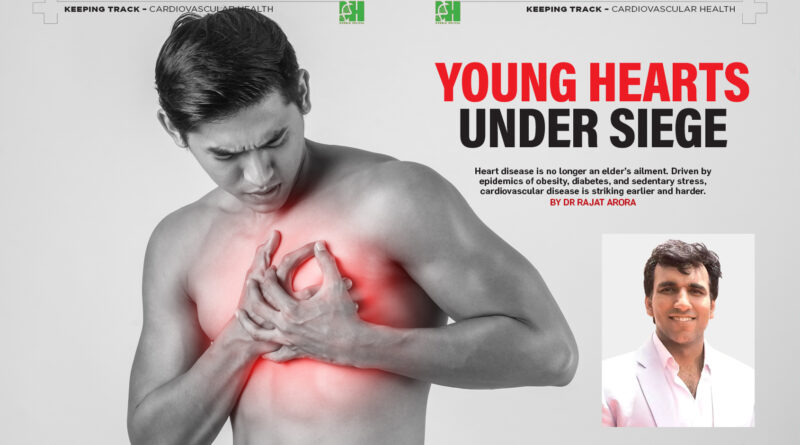
Young Hearts Under Siege
 Heart disease is no longer an elder’s ailment. Driven by epidemics of obesity, diabetes, and sedentary stress, cardiovascular disease is striking earlier and harder.
By Dr Razat Arora
A contemporary snapshot of global cardiovascular health reveals a disturbing and counterintuitive trend: the young are now more vulnerable to heart disease than ever before, increasingly bearing a burden once associated with older age. This shift is starkly visible in India, where the twin spectres of obesity and diabetes are no longer looming threats but active epidemics, directly fuelling the lion’s share of cardiovascular problems among the youth.
The consequence is a public health crisis where heart attacks and cardiac arrests in people in their 30s and 40s have become frighteningly frequent, losing their shock value and beginning to appear almost inevitable.
The data underscores a silent emergency. World Heart Day was established in 2000 to underscore the fact that heart disease and stroke are the world’s leading causes of death, claiming 17.3 million lives annually—a number that continues to climb. Projections indicate that by 2030, cardiovascular diseases (CVDs) will claim a staggering 23 million lives each year. While the death of a 70 or 80-year-old may attract little attention, the sudden collapse of a 30- or 40-year-old should rightfully cause widespread alarm.
Yet, in India, this is becoming commonplace. It is deeply worrisome that out of every 100 people suffering major cardiac ailments today, 40 per cent are between 30 and 40 years of age. To put this generational shift in perspective, just three decades ago, the incidence of coronary artery disease (CAD) leading to heart attacks in the young was a mere two percent. Today, that figure has skyrocketed to an alarming 14 percent, representing a sevenfold increase.
This crisis also shatters a persistent and dangerous myth: that heart disease is a condition reserved for affluent, older men. The World Heart Federation has revealed a starkly different reality. Heart disease is, in fact, the number one killer of women globally, responsible for one in three female deaths. Shockingly, this translates to approximately one woman dying from heart disease every single minute worldwide. This data collectively signals that the heart health of younger populations is under severe and unprecedented attack.

The “Heart Age” Wake-Up Call
A landmark study, the India Today – Saffolalife Study, which surveyed 46,000 urban Indians, provided a crucial metric for understanding this crisis: the concept of “heart age.” The findings were startling, showing that 78 percent of men between the ages of 30 and 34 are at risk of a heart attack, with their biological “heart age” significantly older than their chronological age. This concept was popularised in India around 2009 through a collaboration between the World Heart Federation and Marico Ltd. It utilises algorithms like the one from the long-running Framingham Heart Study (FHS), which calculates an individual’s heart age based on key biological and lifestyle factors: chronological age, gender, blood pressure, cholesterol levels, tobacco use, diabetes status, and body mass index (BMI).
The growing awareness of “heart age” has prompted many young Indians to assess their cardiovascular risk profile. However, calculation is merely the diagnostic first step; the real work lies in precaution and prevention. It is imperative to identify and address the specific factors contributing to premature heart weakness.
Decoding the Risk Factors for a Young Heart
The traditional risk factors for coronary artery disease remain potent: a strong family history, dyslipidaemia (abnormally high cholesterol and triglyceride levels), hypertension (high blood pressure), abdominal obesity, diabetes, and metabolic syndrome. However, for the younger generation, modifiable behavioural factors play an outsized, accelerating role.

A sedentary lifestyle, characterised by a profound lack of physical exercise, is a giant contributor. This is compounded by chronic, unmanaged psychological stress—a ubiquitous feature of modern urban life—and poor dietary habits high in processed foods, sugars, and unhealthy fats.
Perhaps the single most significant avoidable risk is tobacco use. Extensive research has unequivocally established that both active and passive smoking are devastating to cardiovascular health. The chemicals in tobacco smoke damage the lining of the arteries, promote inflammation, increase blood pressure, and reduce good cholesterol (HDL). Alarmingly, children exposed to second-hand smoke over extended periods are at a significantly higher risk of developing early-onset cardiac problems, laying a dangerous foundation for their future health.
A Path to Prevention: Lifestyle as Medicine
The rising mortality rate from cardiac arrests among young adults necessitates an urgent, paradigm-shifting response. Increased public awareness about the non-negotiable importance of exercise and a holistic healthy lifestyle is the most powerful tool to reverse this trend. While congenital heart conditions exist, an individual’s risk trajectory is overwhelmingly determined by their choices in adulthood.
In today’s fast-paced world, stress may be unavoidable, but its impact is manageable. Incorporating just 30 minutes of moderate-intensity exercise, such as brisk walking, cycling, or home workouts, for five days a week, can work wonders for cardiovascular resilience, stress reduction, and metabolic health.
A drastic, collective change in lifestyle and eating habits is the need of the hour, with a special focus on safeguarding the youth. Prevention must begin in childhood. Encouraging the consumption of a balanced, whole-foods diet rich in fruits, vegetables, whole grains, and lean proteins from an early age, combined with ensuring adequate daily physical activity, is the cornerstone of building lifelong heart health.

The World Health Organization offers a powerful message of hope: an estimated 80 percent of premature deaths from heart disease and stroke are preventable. This prevention hinges on controlling main risk factors—primarily tobacco use and unhealthy diet—and embracing a more physically active life. The power to protect the young heart lies not in advanced medical technology alone, but in the fundamental, daily choices we make and promote as a society.
(The author is an Interventional Cardiologist at Yashoda Superspeciality Hospital, Ghaziabad.)