
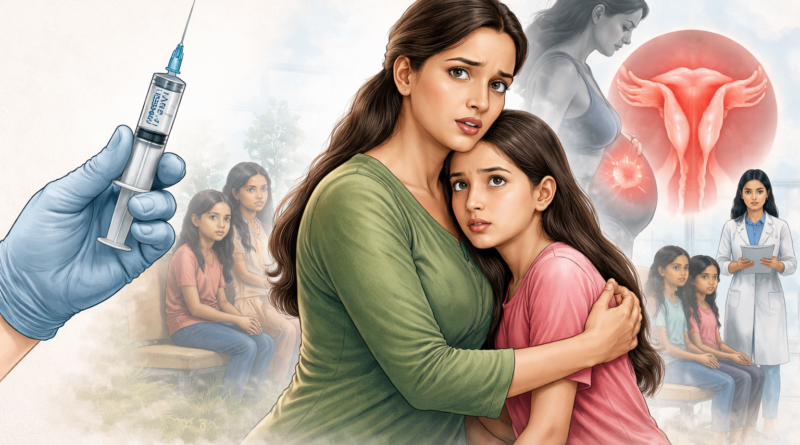
Playing with Daughters’ lives
 The average age of cervical cancer is 50—four decades after the shot. No trial has followed recipients that long. Seven tribal girls are already dead from unethical vaccine trials. Yet we’re rushing to roll this out to millions.
By Dr Amitav Banerjee
Two years back, a struggling starlet and model, Poonam Pandey, had her one minute of fame. The news of her death from cervical cancer
at the young age of 32 years sent shock waves. A couple of days later, she rose
like a phoenix from “death,” creating a sensation. What was the method in this madness? According to her, she enacted this drama for a noble cause: to draw attention to cervical cancer, which affects a large number of women in the country. Her stunt was similar to the mother coaxing her child to go to sleep, else “Gabbar,” the dacoit , will come — to borrow the phrase from the popular Hindi movie Sholay: Beta so ja nahin to Gabbar aa jayega! She perhaps wanted to shock all girls into taking the Human Papilloma Virus (HPV) vaccine , else they may die from cervical cancer: Vaccine le le, nahin to “Cervical Cancer” aa jayega!
For many, this frivolity left a bad taste in the mouth. Was it a coincidence that a day before the news of her death, on 01 February 2024, the Union Budget announced its intention to push for preventive vaccination against cervical cancer for girls aged 9 to 14 years? Keep in mind that the average age of getting cervical cancer is 50 years, about four decades later. Will the promise of the vaccine to prevent cervical cancer hold good four decades down the line? These are some serious questions which cannot be wished away by frivolous stunts. We need solid evidence. Propaganda is short-lived and often backfires. What is the current evidence?
Current Evidence Linking HPV Virus to Cervical Cancer and the Uncertainties
The concept of prevention by vaccination is based on the fact that one of the causes of cervical cancer is the HPV virus, which has over 200 types. Types 16 and 18 have been associated with precancerous lesions of cervical cancer, while types 6 and 11 are associated with genital warts. Other HPV strains linked to cervical cancer are, 31, 33, 35, 39, 45, 51, 52, 56, 58, and 59. The natural history of these precancerous lesions does not follow a straight path. The majority of these lesions are self-limiting and clear without treatment. Therefore, using these proxy markers instead of the main outcome, i.e. , cervical cancer , can overestimate the efficacy of the HPV vaccines. Most trials have followed up the vaccine recipients for less than a decade , using surrogate markers such as clearance of HPV virus and antibody response. All these endpoints are a poor substitute for predicting cervical cancer decades later. Another limitation is that the measure of efficacy of most HPV vaccine trials has been the relative risk instead of the attributable risk , which depends on the prevalence of HPV virus infection in a particular population , which has shown wide variations from 2 per cent to 50 per cent, being highest in commercial sex workers and people with HIV/AIDS.
Most trials have followed up the vaccine recipients for less than a decade, using surrogate markers such as clearance of HPV virus and antibody response. All these endpoints are a poor substitute for predicting cervical cancer decades later.
For a detailed critique of the available evidence, one should refer to a peer-reviewed paper by Rees and colleagues in the prestigious Journal of the Royal Society of Medicine, titled, “Will HPV vaccination prevent cervical cancer?” The authors conclude there is great uncertainty whether the vaccine prevents cervical cancer. Another disconcerting feature of the HPV virus is that it has 200 types, and the vaccine covers only a few types. We do not know whether vaccine pressure can cause other strains not covered by the vaccine to become dominant , becoming a risk for cervical cancer. Because of these
uncertainties, even the manufacturers of the vaccines recommend that even after taking the HPV vaccine , women should keep undergoing periodic screening with PAP smear for early detection of cervical cancer.
Serious Work, Including Social Research on Sexual Behaviour, Needed Before Promotion and Propaganda
We really do need more serious scientists doing serious research to resolve these issues instead of film stars and public figures, including “celebrity doctors,” promoting vaccines in the manner of advertisementsfor fast foods. Fast foods have their downside, leading to obesity and a number of chronic diseases. Similarly, vaccines promoted like fast foods without careful research can have their downside. Some efforts are required to promote good health, including safe sex , to prevent cervical cancer. The HPV virus is sexually transmitted , just like other sexually transmitted diseases such as syphilis, gonorrhoea, HIV/AIDS, Hepatitis B , and Hepatitis C. The risk factors for HPV infection and cervical cancers are multiple sex partners, unprotected sex, poor genital hygiene, and repeated pregnancies. A holistic approach to preventing all sexually transmitted diseases, including HPV infection , would be to educate young boys and girls about responsible and safe sexual behaviour during their lifetime. Would getting an HPV vaccine protect against HIV, for which there is no vaccine? One can use this scientific information to stress among the youth the need for responsible sexual behaviour.
Falling Trends of Cervical Cancer in India Call for Proper Risk- Benefit Evaluation, Before Rushing for Mass Rollout. Caution Called for in the Context of Past Misadventures
A recent paper by Singh and co-workers published in BMC Cancer , shows that the trend of cervical cancer is declining in India for the past three decades. Presently, there are an estimated seven deaths per lakh population per year from cervical cancer , down from 13 , three decades ago. The AIDS pandemic during this period is likely to have created awareness about safe sex , in addition to better living standards , including genital hygiene , all adding up to the steep fall in cervical cancer in many states of India. Shouldn’t we wait and watch the declining trend further instead of including the HPV vaccine in the UIP in the midst of so many uncertainties? Or , by pushing mass vaccination , do we muddy the waters , which will destroy all evidence by elimination of the control group , which is essential to establish the efficacy or harm, if any, of the HPV vaccine?
Past Misadventures During Clinical Trials Among Teenagers
The latter assumes significance in view of the chequered history of the HPV trials in India. The Bill and Melinda Gates Foundation , through its Program for Appropriate Technology in Health (PATH), conducted trials among vulnerable tribal girls in Andhra Pradesh and Gujarat from 2009 to 2010. To bypass ethical issues, the investigators labelled the trials as observational instead of a clinical trial. During the trial, seven girls out of the 26,000 who took the HPV jabs , died. The girls were residents of a government hostel for tribal children. The investigators , including scientists from the ICMR , denied that the deaths were due to the vaccine. As a result of public outcry, the trial was halted. The tragedy was investigated by a Joint Parliamentary Committee. The Committee tabled its report — the 72nd Report titled, “Alleged Irregularities in the conduct of studies using human papilloma virus ** (HPV)** vaccine,” — on August 30, 2013 , to both houses of parliament. The committee found many major irregularities and indicted the Gates Foundation, the ICMR , and the researchers for dereliction of duty. Interestingly, the current Minister of Health and Family Welfare, J P Nadda , was a member of the 72nd Joint Parliamentary Committee that attributed the death of 7 girls to the unethical trials of the HPV vaccine. The committee also spelled out the gross irregularities in the trial , concluding that crash commercial interest was the motive pushing the HPV vaccine. Unfortunately, public memory including that of the Health Minister, seems to be short. Professionals like doctors promoting the vaccine unconditionally also seem to be unaware of the uncertain evidence of efficacy and the botched – up trials leading to the deaths of seven vulnerable tribal girls. The glitz and glamour of high-pressure marketing is poised to brush these uncomfortable truths under the carpet. One should not erase from public memory that seven tribal teenagers out of 26,000 jabbed died during unethical trials of the HPV vaccine. they not taken the vaccine , their chances of death from cervical cancer decades later would have been 7 out of 100,000 , as estimated from current statistics. Compare this with seven out of 26,000 who died during the trial. This should be a red signal to be heeded before mass HPV vaccine rollout in unholy haste , given that we do not have a robust adverse events following immunisation (AEFI) monitoring system in the country. Given these shortcomings , it is unlikely that adverse events from the HPV vaccine would be captured adequately. We cannot roll out superfast trains on dilapidated old tracks.
Seven tribal teenagers out of 26,000 jabbed died during unethical trials of the HPV vaccine. Had they not taken the vaccine, their chances of death from cervical cancer decades later would have been seven out of 100,000, as estimated from current statistics. Compare this with seven out of 26,000 who died during the trial.
The Way Forward
Given the uncertainties, it would be premature to include the HPV vaccine in the Universal Immunisation Programme at huge cost and resources, with the taxpayer’s money. Let it be in the market for those who want to go for it. This strategy will also generate a control group for long-term appraisal of efficacy and safety. Universal rollout, on the other hand, will erase the control group , and we may never have the answers to these uncertainties.
The Author is a renowned epidemiologist and a Professor Emeritus at D Y Patil Medical College, Pune. Having served as an epidemiologist in the armed forces for over two decades, he ranked in Stanford University’s list of the world’s top 2 per cent scientists for three consecutive years (2023-25). He has penned the book, Covid-19 Pandemic: A Third Eye.A different version of this “devil’s advocacy” was published in the proceedings of the Indian Medical Association’s Academy of Medical Specialties Conference, AMSCON 2025