

The Silent Joint Burden
A widespread yet often misunderstood condition, arthritis affects millions and manifests through pain, stiffness, and reduced mobility—making early diagnosis and tailored treatment essential.
By Abhigyan/Abhinav
If you are experiencing symptoms like aching joints, difficulty in dressing or combing hair, gripping objects, sitting or bending over,
joints being warm to the touch, morning stiffness for less than an hour, pain when walking, stiffness after resting, swelling of joints, and loss of motion in a joint, you must consult an orthopaedician. You might have arthritis, as these are its common symptoms.
In common parlance, arthritis is a condition that affects more than 10% of the adult population. There are more than 100 different types of arthritis. The false notion that all forms of arthritis are alike has led people to try treatments that have little effect on their symptoms. Since each type of arthritis is different, each type calls for a different approach to treatment. That means an accurate diagnosis is crucial for anyone who has arthritis.
There are two major types of arthritis — osteoarthritis, which is the “wear and tear” arthritis, and rheumatoid arthritis, an inflammatory type of arthritis that occurs when the body’s immune system does not function properly. Gout, which is caused by crystals that collect in the joints, is another common type of arthritis. Psoriatic arthritis, lupus, and septic arthritis are other types.

Osteoarthritis is also called degenerative joint disease or degenerative arthritis. It is the most common chronic joint condition. Osteoarthritis results from overuse of joints, but most commonly it is an aging phenomenon. It can be the consequence of demanding sports where joints may be injured or obesity, which places increased load on weight-bearing joints. Osteoarthritis in the hands is frequently inherited and often occurs in middle-aged women . Osteoarthritis is most common in joints that bear weight — such as the knees, hips, feet, and spine. It often develops gradually over months or even years. Except for the pain in the affected joint, you usually do not feel sick, and there is no unusual fatigue or tiredness, as seen in some other types of arthritis. With osteoarthritis, the cartilage gradually breaks down. Cartilage is a slippery material that covers the ends of bones and serves as the body’s shock absorber. As more damage occurs, the cartilage starts to wear away, or it does not function as effectively as it once did to cushion the joint. For example, the extra stress on knees from being overweight can cause damage to knee cartilage, which in turn causes the cartilage to wear out faster than normal.
As the cartilage becomes worn, the cushioning effect of the joint is lost. The result is pain when the joint is moved. Along with the pain, sometimes you may hear a grating sound when the roughened cartilage on the surface of the bones rubs together. Painful spurs or bumps may appear on the ends of the bones, especially on the fingers and feet. While not a major symptom of osteoarthritis, inflammation may occur in the joint lining as a response to cartilage breakdown.
Rheumatoid arthritis is the most common type of inflammatory arthritis. About 75% of those affected are women. In fact, between 1% and 3% of women are likely to develop rheumatoid arthritis in their lifetime.
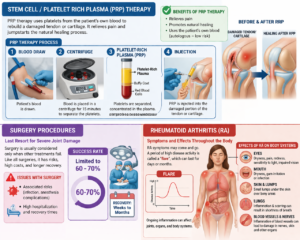
Rheumatoid arthritis is an autoimmune disease. This means that the immune system attacks parts of the body. The joints are the main areas affected by this malfunction. Over time, chronic inflammation can lead to severe joint damage and deformities. About one out of every five people with rheumatoid arthritis develops lumps on their skin called rheumatoid nodules. These often develop over joint areas that receive pressure, such as the knuckles, elbows, or heels.
Symptoms of rheumatoid arthritis can come on gradually or start suddenly. Unlike osteoarthritis, these symptoms are often more severe, causing pain, fatigue, loss of appetite, and stiffness. With rheumatoid arthritis, you may feel pain, stiffness, and swelling in your hands, wrists, elbows, shoulders, knees, ankles, feet, jaw, and neck. Sometimes the pain occurs in one part of the body, but more commonly it affects multiple joints, such as the hands, knees, and feet. With rheumatoid arthritis, the joints tend to be involved in a symmetrical pattern. That is, if the knuckles on the left hand are inflamed, those on the right hand are likely to be inflamed as well. Over time, more joints may gradually become involved, accompanied by persistent swelling that interferes with daily activities such as opening a jar, driving, working, and walking. Arthritis is a chronic pain condition, and pain relief remains the primary goal of treatment and disease management strategies. Currently, there is no cure for arthritis. Treatment is aimed at controlling symptoms and slowing disease progression. In other words, medications and therapies may have analgesic (pain-relieving), anti-inflammatory, and disease-modifying effects.
The goal is to improve quality of life and slow joint destruction. People with certain types of arthritis, such as rheumatoid arthritis, may achieve remission with treatment; however, remission is not a cure.
Researchers are continually developing new and improved treatments for arthritis. Patients are encouraged to stay informed and discuss emerging options with their doctors to determine the most appropriate course of treatment. Over-the-counter (OTC) medications for pain relief, such as acetaminophen and nonsteroidal anti-inflammatory drugs (NSAIDs) like ibuprofen or naproxen sodium, can help alleviate arthritis pain. OTC acetaminophen can reduce mild to moderate arthritis pain, particularly in osteoarthritis. In addition to medications, supplements and topical creams available over the counter may also help alleviate arthritis pain. Among the most popular supplements used by people with osteoarthritis are glucosamine and chondroitin. In those with moderate to severe knee pain, the combination of glucosamine and chondroitin sulfate may provide relief, although studies have not conclusively proven their effectiveness for everyone. In addition to OTC NSAIDs, physicians may prescribe stronger NSAIDs to manage arthritis pain and inflammation. These may also be available in topical and injectable forms. Examples include diclofenac and other similar medications. Potent anti-inflammatory agents like Synvisc One can be injected to reduce pain and inflammation. Ozone gas injections have also been clinically proven to be effective in pain relief.
Over 100 types, arthritis demands accurate diagnosis, as each form requires a distinct treatment approach
While there is no cure, timely intervention, medication, and emerging therapies can significantly improve quality of life.