
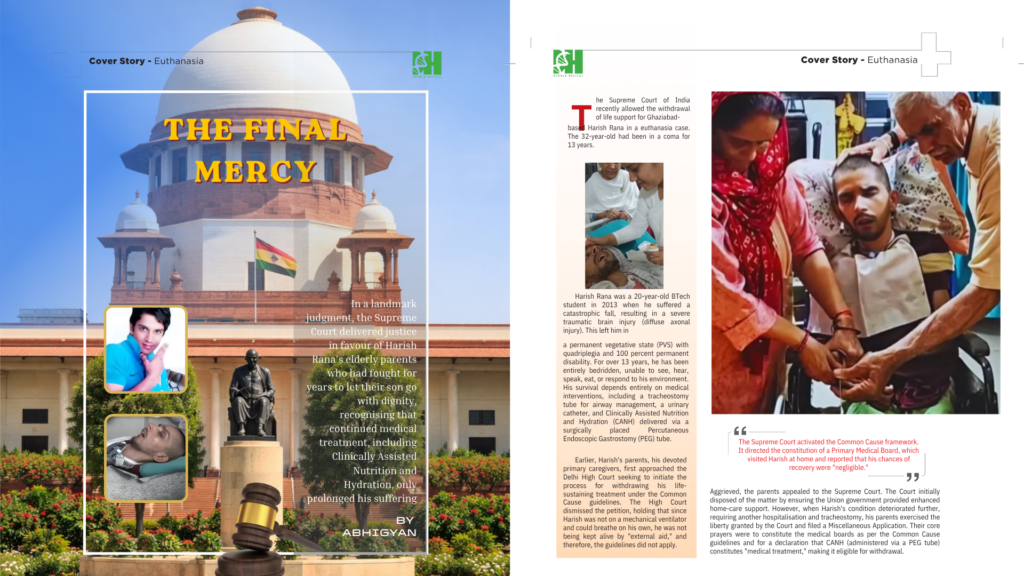
The Final Mercy
In a landmark judgment, the Supreme Court delivered justice in favour of Harish Rana’s elderly parents who had fought for years to let their son go with dignity, recognising that continued medical treatment, including Clinically Assisted Nutrition and Hydration, only prolonged his suffering
By Abhigyan
The Supreme Court of India recently allowed the withdrawal of life support for Ghaziabad-based Harish Rana in a euthanasia case. The 32-year-old had been in a coma for 13 years. Harish Rana was a 20-year-old BTech student in 2013 when he suffered a catastrophic fall, resulting in a severe traumatic brain injury (diffuse axonal injury). This left him in a permanent vegetative state (PVS) with quadriplegia and 100 percent permanent disability. For over 13 years, he has been entirely bedridden, unable to see, hear, speak, eat, or respond to his environment. His survival depends entirely on medical interventions, including a tracheostomy tube for airway management, a urinary catheter, and Clinically Assisted Nutrition and Hydration (CANH) delivered via a surgically placed Percutaneous Endoscopic Gastrostomy (PEG) tube. Earlier, Harish’s parents, his devoted primary caregivers, first approached the Delhi High Court seeking to initiate the process for withdrawing his life-sustaining treatment under the Common Cause guidelines. The High Court dismissed the petition, holding that since Harish was not on a mechanical ventilator and could breathe on his own, he was not being kept alive by “external aid,” and therefore, the guidelines did not apply.
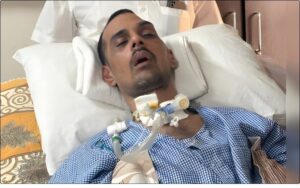
The Supreme Court activated the Common Cause framework. It directed the constitution of a Primary Medical Board, which visited Harish at home and reported that his chances of recovery were “negligible.”
Aggrieved, the parents appealed to the Supreme Court. The Court initially disposed of the matter by ensuring the Union government provided enhanced home-care support. However, when Harish’s condition deteriorated further, requiring another hospitalisation and tracheostomy, his parents exercised the liberty granted by the Court and filed a Miscellaneous Application. Their core prayers were to constitute the medical boards as per the Common Cause guidelines and for a declaration that CANH (administered via a PEG tube) constitutes “medical treatment,” making it eligible for withdrawal. Recognising the gravity of the situation, the Supreme Court activated the Common Cause framework. It directed the constitution of a Primary Medical Board, which visited Harish at home and reported that his chances of recovery were “negligible.” It then directed AIIMS, New Delhi, to constitute a Secondary Medical Board. This board, after a thorough examination, confirmed that Harish was in an “irreversible permanent vegetative state” for the past 13 years and that continued CANH, while required for survival, would “not aid in improving his medical condition or repairing his underlying brain damage.” The Court also facilitated interactions with the family. The parents, now elderly, expressed their agonising decision with profound clarity: they have done everything humanly possible for 13 years, their son has no quality of life or awareness, and continuing treatment only prolongs his suffering and indignity. Their decision was a selfless act of love, taken in what they genuinely believed to be his best interests. Ultimately, the Supreme Court delivered justice in favour of Harish Rana’s parents.
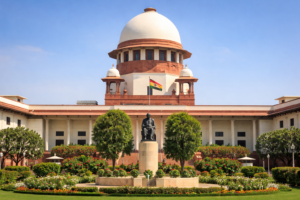
What is Euthanasia?
Euthanasia is the painless killing of a patient suffering from an incurable and painful disease or who is in an irreversible coma.In India, euthanasia is one of the most debated issues in the legal arena because it exists at the intersection of medical ethics , institutional policies, and individual self-determination. The Supreme Court has always sought to interpret the constitutional provisions as broadly as possible to ensure the maximum welfare of the people. Consequently, the Supreme Court has incorporated the right to die with dignity into the Indian Constitution as an important aspect of the right to life. The apex court analysed the applicability of euthanasia in various rulings and finally legalised passive euthanasia in the Aruna Shanbaug case, bringing great relief to terminally ill patients. It is illegal to treat a conscious, sane adult without their consent. Patients in a permanent vegetative state (PVS) who are unlikely to improve cannot make decisions about the treatment they receive. Ultimately, the court will decide in the patient’s best interest. The entire human existence is a complicated process, evolving to be who we are and how we live through a complicated web of events. Animals cannot decide on simple or difficult matters in life; we can choose, and we may achieve our goals through hard work. Imagine living a life in which you are breathing, your heart rate, body temperature, and sleep cycles are functioning, but you are unable to talk or act, and you are unaware of your surroundings and yourself. You may even lose conscious intention. This clarifies why someone would be in a vegetative condition.
Harish Rana’s elderly parents, expressed their agonising decision with profound clarity: they have done everything humanly possible for 13 years, their son has no quality of life or awareness, and continuing treatment only prolongs his suffering and indignity.
When the brain stem and hypothalamus continue to function but the cerebrum stops working, this is known as a vegetative state. Everyone aspires to lead a fulfilling life. In ancient Greece and Rome, assisted dying was admissible in some situations. For illustration, in the Greek city of Sparta, babies with birth defects were put to death. The father of medicine, the Greek physician Hippocrates, opposed this act of killing as a breach of the bond between physician and patient Numerous ancient texts , including the Bible, the Koran, and the Rig Veda, mention self-destruction or suicides committed on religious grounds. The Mahabharata and the Ramayana are also full of instances of religious self-destruction. Govardana and Kulluka, while writing commentaries on Manu, observed that a man might undertake the Mahaprabhu (great departure) on a trip that ends in death when he is incurably diseased or meets with a great mischance, and that this is not opposed to Vedic rules, which prohibit suicide. Muslims are against euthanasia. They believe that all mortal life is sacred because it is given by Allah and that Allah chooses how long each person will live. Christians are largely against euthanasia. Sikhs derive their ethics largely from the teachings of their book, Guru Granth Sahib, and the Sikh Code of Conduct. The Sikh Gurus rejected suicide as a hindrance to God’s plans.

In India, euthanasia is one of the most debated issues in the legal arena because it exists at the intersection of medical ethics, institutional policies, and individual self-determination. The Supreme Court has always sought to interpret the constitutional provisions as broadly as possible to ensure the maximum welfare of the people.
In Jainism, voluntary death is practiced by Jains where a person freely gives up food and drink so that they are starved till death. In India, the contention whether the ‘right to live’ includes within its dimensions the ‘right to die’ came for consideration for the first time in 1987. It was in the case of the State of Maharashtra vs. Maruti Shripati Dubal , wherein the Bombay High Court held that everyone should have the freedom to dispose of their life as and when they desire. There had been conflicting opinions of various courts across India, with the Andhra Pradesh High Court , in P. Chenna Jagadeeswar vs. State of Andhra Pradesh, holding that an attempt to commit suicide is legal and constitutionally valid. But then, in P. Rathinam vs. Union of India, the Supreme Court of India for the first time time formulated fifteen questions and raised the issue “whether an Indian citizen resident in India has a right to die?” At the end of the judgment, it was held that “attempt to commit suicide” is an outdated, cruel, and illogical provision. Thus, it is violative of Article 21 of the Constitution of India and is void and unconstitutional. The ruling in P. Rathinam’s case was overturned in Gian Kaur vs. State of Punjab, a significant ruling in the history of euthanasia. The Supreme Court ruled that a person’s “right to life” does not –
In the landmark case of Aruna Ramachandra Shanbaug vs. Union of India and Ors., passive euthanasia was legalised under stringent guidelines, revolutionising the field of medicine. India now allows passive euthanasia thanks to this historic ruling.
– include their “right to die,” adding that Article 21 forbids reducing a person’s natural life expectancy. Providing a decent existence till death, including a dignified manner of passing away, was part of it. The case of Naresh Marotrao Sakhre vs. Union of India established that Section 309 of the Indian Penal Code does not apply to acts of euthanasia, suicide, or attempts at mercy killing. There are factual and legal distinctions between the two ideas. Whatever the circumstances surrounding its commission, euthanasia, sometimes known as mercy killing, is nothing more than homicide. In the landmark case of Aruna Ramachandra Shanbaug vs. Union of India and Ors., passive euthanasia was legalised under stringent guidelines, revolutionising the field of medicine. India now allows passive euthanasia thanks to this historic ruling. Justice M. Jagannadha Rao served as chair of the Law Commission that produced the 196th Report on “Medical Treatment to Terminally Ill Patients” (protection of patients and medical professionals). This report was created with patients with terminal illnesses or those in a prolonged vegetative state in mind, giving them the opportunity to pass away naturally. The guidelines outlined in this report are international in nature, as courts in the United Kingdom, the United States of America, Ireland, Scotland, Canada, Australia , and New Zealand all apply the same standards to competent patients. So, euthanasia, sometimes known as “mercy killing,” is a sensitive and divisive topic in India. Section 309 of the Indian Penal Code, which forbids attempted suicide and aiding and abetting suicide, presently forbids active euthanasia in India. However, passive euthanasia — which is refusing life support or ending life-sustaining medical treatment — is permissible in some situations. Overall, the legal and ethical implications of euthanasia in India are complex and require careful consideration and discussion. It remains to be seen whether euthanasia laws will evolve in the future to reflect changing attitudes and beliefs.